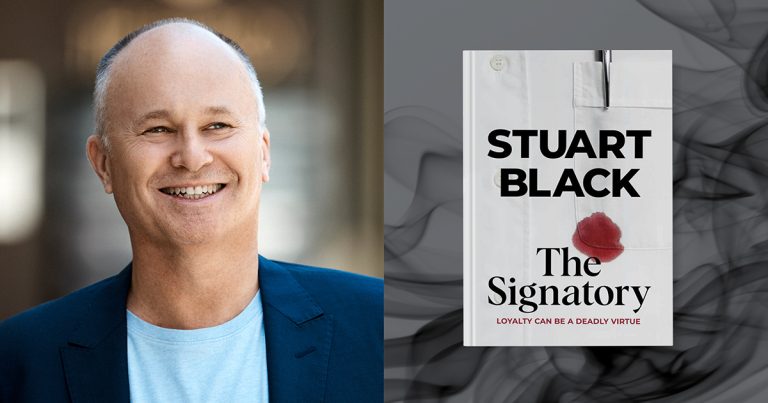
Briefly tell us about your book.
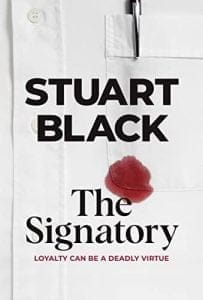
At its heart, The Signatory is about power and how it is so often abused by those who have it.
The protagonist is a guy named Sam Pride, who has just sold the ad agency he started for a lot of money, and he feels like all his dreams have come true. He’s married to a woman he loves deeply, and he suddenly has the financial freedom to do whatever he wants with his life.
But things are not quite as they appear. Particularly regarding the global company that acquired Sam’s Australian business. Suddenly Sam’s picture-perfect world begins crumbling around him. In ways he couldn’t have imagined. There are serious crimes that have been committed and serious people who will do anything to cover them up. Now Sam needs to work out what really matters to him. And who really matters to him. And he has to fight for what he believes in. Or lose everything.
What inspired the idea behind this book?
The idea came from the work I do. Advertising. I have worked in the industry for many years and back in 2007, I started my own agency (with a few friends). The problem I wanted to address in The Signatory is not one limited to advertising. It is that in business, every day, there are people who willingly hurt others to try and make an extra dollar. Some people say that business is war. That you have to hurt others to succeed. I fundamentally disagree. And that’s what this book is about. And I’m not just talking about big business. The problem is there at a global level, but it’s also there at a local level when the sole trader struggling to make a dollar has to negotiate their new lease with a powerful landlord. Or when a large lender has to decide whether or not to extend a loan.
What are you hoping the reader will take away from reading your book?
In the first instance, I hope they are entertained by the novel. I hope they engage with the characters and find the story compelling enough to want to keep reading.
In the second, I hope they consider for a moment who is really doing the wrong thing in the novel (and by extension, in the world around them). While the criminals who ‘pull the trigger’ are easy to spot, there are also the enablers behind the scenes. Those who make it possible for the perpetrators to commit their violent crimes. And in some cases, they are the real instigators. If one single reader chooses not to look away the next time they see someone in their world hurting another person, whether in business or on the street, whether directly or indirectly, then that would be a wonderful result.
Tell us about your background and what led you to writing this book.
I am the founding partner and Group CEO of the region’s leading healthcare communications business. Having begun my working life in media, I moved to adland pretty quickly and eventually found a place at Saatchi & Saatchi London. A few years after moving back to Sydney, we opened Ward6, soon to be named Adnews’ Emerging Agency of the Year. On the back of Sydney’s success, we opened a Singapore office to serve the growing APAC market. By mid-2018, I was running four different advertising agencies.
My passion for creative writing emerged at a young age leading to countless song lyrics and piles of unpublished manuscripts. In 2003 I had a manuscript short-listed for the NSW Writers’ Centre Popular Fiction Competition and in 2009 published the psychological thriller, Shallow Water.
Despite the demands of my day job, I still find time to play the piano, and I never stop writing crime fiction. In my new novel, it’s my intimate knowledge of the international corporate world that gives The Signatory its authenticity. But it is my love of storytelling that, I hope, makes it a great read.
What’s your daily writing routine like and what are you working on at the moment?
A typical day might start with me checking emails, then spending an hour working on my new novel, followed by a walk down to the beach with my wife. Quick breakfast and then off to the office in Surry Hills. I have a hundred and ten staff and it’s a service business, so there are a lot of meetings. There is always a new strategy or a new brief to consider, where we’re trying to be more creative and more innovative than any of our competitors. Eventually it’s home time, another walk, play a song on the piano, dinner, watch a movie, a little more work on the novel, and bed. If it’s a weekend, then catching up with friends and family becomes a top priority. And a dose of sport.
The novel I am working on now is a genuine puzzle. I am loving the process of teasing the reader with clues that comes from both the characters’ back stories and the unfolding action. The central issue I am addressing is whether people can break out of the life-patterns they are born into. And if they can, how do they do that? It’s a play around the theme long explored that is at the heart of the ‘7 Up’ television series (which I loved).

Your review is very great https://geometrydashbloodbath.com