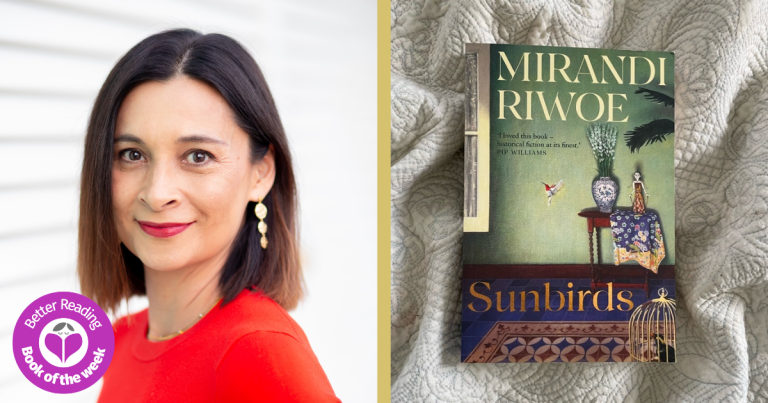
Briefly tell us about your book
Sunbirds is set in the Dutch East Indies (Indonesia), during WWII. Mattijs, a Dutch pilot, is engaged to marry Anna, whose family owns a wealthy tea plantation in West Java. The housekeeper, Diah, is torn between loyalties to the family and her brother, Sigit, who is an Indonesian freedom fighter. They are all forced to make difficult decisions the closer the Japanese come to invading their land.
What inspired the idea behind this book?
My father is Indonesian-Chinese, while my mum is of Irish-English background and, while between books, my cousin introduced me to a man who’s Eurasian like I am, although he was of Dutch-Indonesian heritage. He told me about how his father, as a baby, was rushed out of Java when the Japanese landed. His grandfather was a pilot with the local Dutch airline, and when the Japanese invaded, the allies absorbed these pilots into their forces. But first, the Dutch pilots demanded their families were evacuated too, which was eventually granted, but left them with very short notice to get them out. After hearing this story, it didn’t take me long at all to think of a scenario featuring a young man, a Dutch pilot, forced into making some tough decisions during this tricky time.
What was the research process like for the book?
I originally researched the Dutch families and pilots who fled Java. I studied a lot of the information regarding the flights to Australia and the Japanese attack on Broome, where many of these evacuees perished. I explored non-fiction work to do with memory and colonisation and Indonesia, and academic work on Eurasian women. I read fiction from the period written by Indonesian writers and Dutch writers, and a lot of memoir by ‘Indos’ (the term for Dutch-Indonesian people) who had to leave Indonesia for good after the war. I wanted to see the juxtaposition between those who look back on those last days of colonised Indonesia with fondness and those who were fighting for independence and freedom from their colonisers.
I also think visiting the place in which the book is set is important. I have been to Indonesia many times with my father, but I felt I needed to look at Java through the eyes of my characters, perhaps search out the colonial features I might have missed before. Of course, this was impossible during the pandemic, but I did travel there as soon as I could, and being there, with Mattijs and Anna and Diah in mind, certainly enhanced my writing experience.
How did you think of the title of the book?
I chose the title Sunbirds very early on. The birds in my book reflect the situation of the characters within its pages: captive birds, tropical birds, birds that find freedom, migratory birds, so I searched out names of birds commonly found in Java. Also, I thought the title Sunbirds had a lovely synchronicity with aeroplanes soaring through the bright Indonesian skies during wartime.
Do you write about people you know? Or yourself?
Sometimes I find a story in something that happens to people I know, or something that they might have told me, but by the time the event or the person is developed in my mind and across copious notes, the story and the characters become distinct from that original inspiration. For example, I wrote a story about a teenage skateboarder, and although I heard my son tell me a couple of the things that happen in the story, and he is a skateboarder himself, by the time I wrote my story, it was clearly not about him at all.
That said, as a feminist, Eurasian writer, I do write about Eurasian or Asian women a lot. Again, their stories are distinct from mine, but I guess some of their insights or experiences are borrowed from my own.
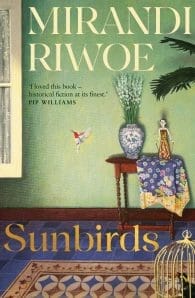
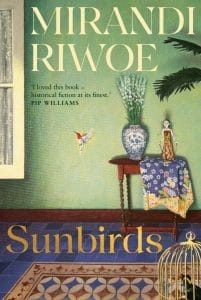
Mirandi Riwoe’s *Sunbirds* is a historical fiction novel set in WWII-era Dutch East Indies, exploring personal and political conflicts as characters face the Japanese invasion. Inspired by a Dutch-Indonesian story, Riwoe’s dedication shines through her meticulous research and travels to Java. The title symbolizes freedom and captivity, reflecting the characters’ struggles, while her identity as a Eurasian feminist subtly enriches her narratives. It promises to be an emotionally and historically resonant tale!
https://www.talktofoodlion.cc