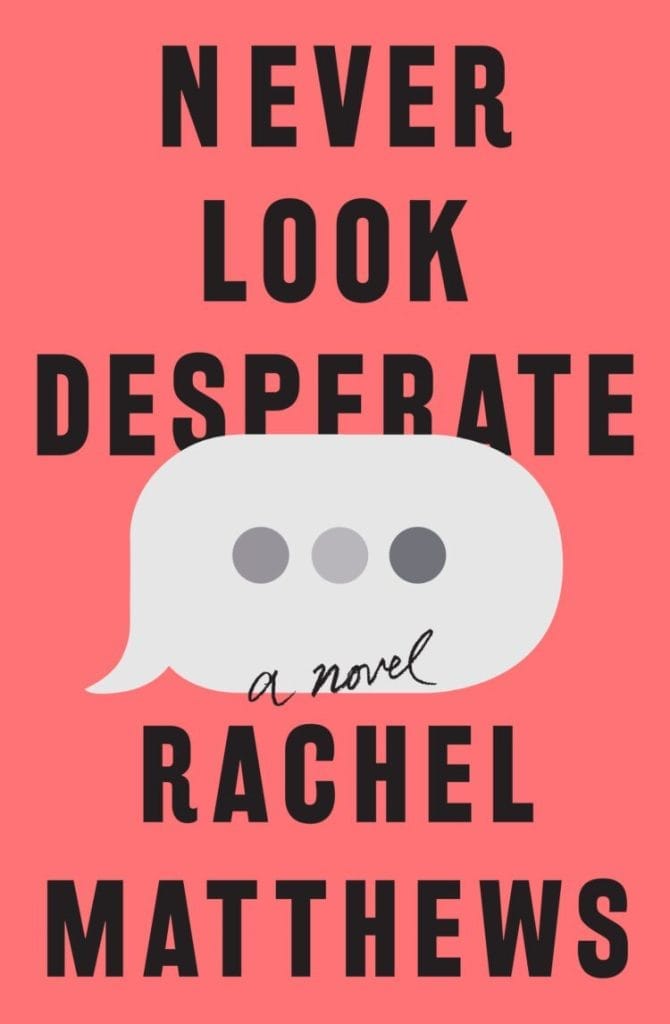
Publisher details
- Author
- Rachel Matthews
- Publisher
- Transit Lounge
- Genre
- Fiction
- Released
- 01 September, 2023
- ISBN
- 9780645565393
Never Look Desperate
Synopsis
Never Look Desperate is Sedaris meets Fleabag, a tragi-comedy romance set in Melbourne 2023. It features: cremation bling, pineapple underwear, grief and vaccinated cruise ships. The central characters Bernard, Goldie and Minh are everything TED Talks tell you not to be.The story tackles the absurdity of despair in a recovering world, the liberation from isolation and the wild frontier of middle-aged Tinder.

Books by Rachel Matthews

Rachel Matthews knows how to write believable and memorable characters.
In her latest book ‘Never Look Desperate: a novel’ she brings to life three ordinary, every-day people resuming their social life after the lockdowns and repercussions of Covid.
What an introduction to the first character, Bernard, who is in his forties and misses his wife who had divorced him and then died. On p1 Matthews writes: With his wife gone and now his father departed, the world, it seemed, would keep taking pieces of him. Then on p9 readers learn more of his late wife: Silvia had seven miscarriages before she left him…. He was sad she had died without holding her child.
As a seven-year-old, the second character Minh had fled Vietnam with her parents and [racial] taunting at school had become part of her day(p12). She was looking for a meaningful relationship with a man.
The third character, Bernard’s mother Goldie had recently lost her husband Marvin and was grieving for him and questioning her life with him, especially as Bernard held her responsible for his death. On p26. Matthews writes: p 26 Goldie tasted everything as though for the first time. Her resounding memory of childhood was the ache of hunger and an old laundry under the house. Her mother had called it the Thinking Room. The cold smell lived deep inside. Goldie could still feel the damp against her body. Immediately readers become aware of depth and complexity to this character.
Readers who usually like to read books written in the third person with access to the point of view of only one character might find it disconcerting to see what is going on in the minds of three people. However, this device, along with a lot of telling as well as showing what is going on, helps round out the characters and helps readers understand the characters’ psyches. Once readers adapt to Matthew’s style of writing, they should enjoy the interaction between the characters and their interactions with others, including Marvin.
Apart from grief, family relationships and sexual relationships, other issues raised in the novel include inter-generational trauma going back several generations, challenges in trying to come to terms with wanting but not having a partner, passing the usual age for parenting children, and losing the ability to have children. Matthews understands the conflicts within the characters she creates and she empathises with them.
Matthews also seamlessly integrates current ethical issues into the story. For instance, after a meditation, Goldie turns on the radio. The ABC was broadcasting a debate called Viral Planet via the Melbourne Town Hall. A doctor from the World Health Organization spoke. ‘What have we spent globally managing the virus? Each year, 525,000 children under the age of five die from dirty drinking water.’
This book would appeal to anyone who likes to read about ordinary people and who wants to work out what makes them tick. Matthews knows the people she writes about and loves them despite their foibles, nerdiness or neediness. Readers are likely to feel the same, and they will think about the characters and the issues they raise long after they finish reading.
I highly recommend ‘Never Look Desperate: a Novel’ and give it a rating of 5 out of 5.