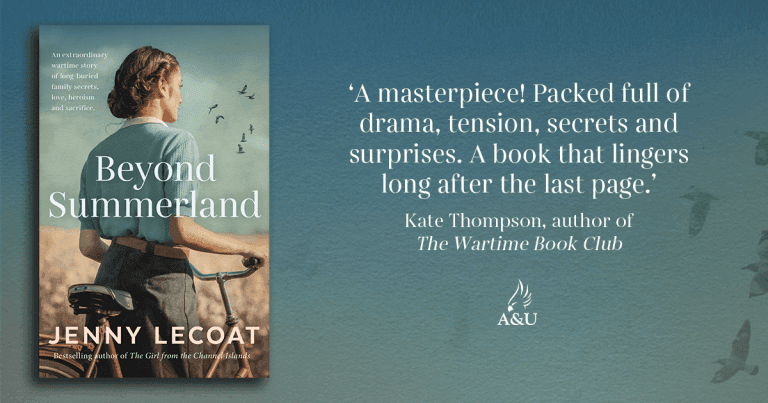
Jersey, Channel Islands
June 1945
Excitement billowed down the street. It poured out of every doorway and crackled in the air, tickling the back of people’s necks, beckoning everyone into this thrilling, historic morning. And what a morning! Yesterday’s storm had vanished north over the English Channel, leaving bright sunshine and a powder-blue sky.
Now the whole of St Helier was waiting, rinsed and gleaming, impatient with anticipation. A stiff south- westerly gusted through the streets of the town, carrying the faint murmur of a distant, chattering crowd, and as she stood on her front path to breathe it all in, Jean felt a surge of genuine optimism. She ran her fingers through her mousy hair to revive its sagging shape, tugged at her jacket to make sure the moth hole in her blouse was hidden, then called back into the house:
‘Mum! Hurry up, or we’ll get stuck at the back.’
Violet Parris shuffled out, her ancient leather handbag perched carefully on her arm. Jean watched as she turned, methodically, to lock the Chubb. It was a habit that recent years had ingrained, and with pilfering still rife around the parish it made sense to be cautious, though everyone missed the days of open front doors. ‘Things will settle down by Christmas,’ people kept saying. And perhaps they would.
Jean took in the pallid face beneath the battered felt hat and considered what a frail, brittle figure her mother cut these days, the anxious, darting eyes and slight stoop of constant burden more pronounced in sunlight than in the gloom of the house. Certainly, most people would have guessed Violet to be older than forty-six. But then, Jean supposed, every living soul on this island had aged a lifetime in the last five years. She felt a sudden urge to reach out and hug her mum tightly but, knowing Violet would balk at such a display, offered her arm instead. They set off at a pace that Jean calculated her mother could maintain for the half-mile walk.
The street was filled with the sound of garden gates clanging as women shooed husbands and children onto the pavement, reknotting ties and smoothing errant strands of hair before scuttling towards the town centre. One or two of them carried folded Union Jacks ready to unfurl at the crucial moment, and Jean felt a pang of envy; their own flag had been used for kindling back in the winter, and no replacements could be bought now. But then, it would be inappropriate for the family to appear in any way frivolous. Jersey was a small island. People liked to talk.
By the time they reached the end of Bath Street the roads were already thick with people heading for the Royal Square. At the corner of the covered market on Halkett Place, two streams of moving bodies became a human river, pushing the pair of them along like paper boats, and Jean wished again that they had set off earlier. As a woman behind stumbled slightly, forcing them both forward, she felt her mother’s fingers tighten on her arm; quickly, Jean tugged her away from the melee towards a quiet side street, where she leaned her mother against a concrete wall, supplying a handkerchief which Violet immediately dabbed across her forehead.
‘All right?’
Violet shook her head. ‘So many people. Why didn’t we go down the Albert Pier, see the SS Jamaica coming in, or find a place along the Esplanade?’
Jean, who had suggested these exact choices last night, merely took the dampened handkerchief back and tucked it into her sleeve.
As she did so, her eyes fell on the shop front, a small bakery set halfway down the turning. The display window had been boarded up to replace the shattered glass, but evidently the vandals had returned for a second visit, because now a huge swastika was painted on the plywood in black pitch. She glanced at her mother and saw that she too had become transfixed by it.
Violet jerked her chin a little. ‘Collaborators.’ Jean nodded. What had the proprietors done to earn such a reputation? Had they served German soldiers their bread? Fraternised with them? She imagined the angry faces of men rushing towards the shop in the dead of night, bricks and rocks in their hands. What had happened to this island in such a few short weeks?
Liberation Day, less than a month earlier, had been the most significant, emotional event that any islander, young or old, had ever experienced. The most longed-for day in their history had come at last and, with the arrival of a British task force in the harbour and the official surrender of the German military, five brutal years of Nazi occupation had finally come to an end. So long and arduous had the Occupation been – Jean was a school- girl of just fourteen when it began – that for the first week or two of freedom she had found the transformation impossible to take in.
To be able to leave the house without curfew . . . to speak openly on the street without fear of spies . . . to listen to the BBC news on a neighbour’s radio! But best of all was the joy of eating a proper meal again, as the British army unloaded crate after crate of supplies, and the Red Cross ship, Vega, brought more relief parcels. Given the near starvation of the previous year, extravagances such as tinned meat, lard for cooking, sugar and tea had moved Jean and Violet to tears of relief as they unpacked their box. The sharp taste of raspberry jam, spooned straight from the jar in a moment of pure elation, would stay with her forever.




Leave a Reply