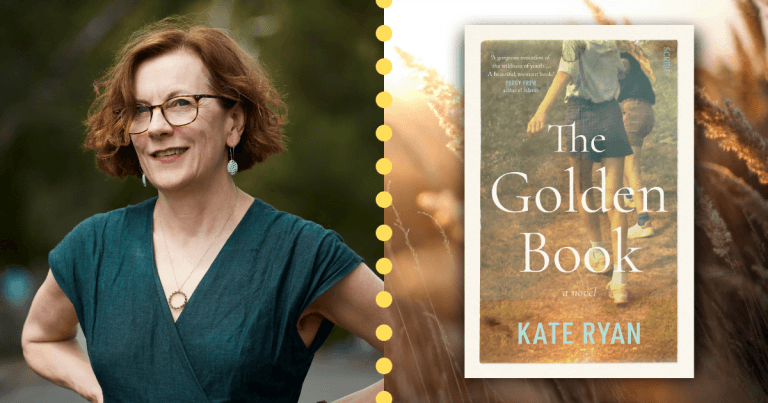
Briefly tell us about your book
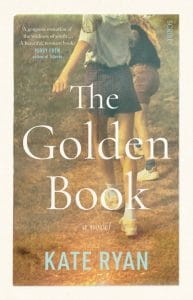
The Golden Book is written from the perspective of Ali, a teacher and the mother of a young daughter. Ali learns of the death of her childhood friend, Jessie Morabito, many years after a catastrophic accident Jessie suffered at Mumbulla Falls in New South Wales when the girls were twelve years old.
The novel explores the underlying forces contributing to the accident – the intertwining of friendship and rivalry, and Jessie’s recklessness. When she is an adult with a young daughter herself, Ali is forced to reckon with ‘The Golden Book’ – the girls’ book of incantation and risk-taking – and to consider questions of responsibility, blame and fear – as well as the nature of love.
What inspired the idea behind this book?
I have always been fascinated – and remember – the intensity of childhood friendships, especially those between girls on the cusp of adolescence. This intensity can almost have the character of a love affair, though physical attraction may not be part of it. I think we can romanticise what it is to be a child, to simplify it too, to forget that the emotions which exist in adults are there in children too – love and hate and fear, for instance – and rivalry between children may run deep. Children are complex beings – and I wanted Jessie and Ali to reflect this. I am interested in the way our childhood best friends are often complimentary selves, possessing traits that we would like to have. A best friend’s family, its strangeness and difference, may be part of their allure too.
Both Jessie and Ali reflect something of me as a child. I was anxious and an obsessive reader like Ali, but also physically confident and adventurous like Jessie. I spent most of my spare time with my best friend Michael, usually barefoot, exploring the neighbourhood. We played elaborate games in and around the grounds of a school we lived next door to, climbing trees and onto roofs. Our friendship was competitive (at least from my perspective). I always wanted to prove, as a girl, that I could do things as well or better than Michael, was tougher and braver.
As an adult, I have become cautious and I sometimes wonder, as with Ali, what happened to my brave child self. In my own life I was 12 when we moved houses and then my father died when I was 13. Both events signalled the end of my friendship with Michael and that particular feeling of childhood freedom and also brought amorphous fear. I have brought many of these emotions to The Golden Book, both directly and indirectly.
What was the research process like for the book?
I read about the history of white settlement in the Bega area and the spiritual significance of Mumbulla Creek Falls and Mumbulla Mountain for the people of the Yuin nation. The area is hugely important spiritually for the First Nations people but they had to fight hard to have this recognised and to reclaim their own land. I visited and spent time at the falls and walked around Bega, up and down its streets, in order to imagine how it might have felt to grow up there in the 1980s when Ali and Jessie did. I found particular houses that felt ‘right’ and imbued them with the girls’ and their families’ ghost lives.
I researched dyslexia, both how it was seen historically and how it is seen today. Understanding of it, and advances in how it is approached in the classroom – as well as how it is for those who actually have the condition – have been slow. I also found in my research that, like many conditions, there is not one ‘version’ of it, but a broad spectrum of how individuals might experience dyslexia. This somewhat explains why it has been hard for children to get the help they need.
I read about nursing homes where young people are forced to live out their lives in the absence of other, more age-appropriate places after catastrophic accidents like Jessie’s.
Initially, I also read about initiations. I was interested in ideas around the transition from childhood to adulthood and how this might be marked (or not) within different cultures.
I read and read and read – a lot of fiction and nonfiction and poetry too. Thinking about and being immersed in the writing of a broad range of writers – both contemporary and historical, Australian and those from all over the world – is my most effective way of making my writing the most powerful it can be.
Who are some of your favourite authors? Or favourite books?
I read constantly, obsessively – and often randomly, according to mood. I have an overflowing stack by my bed that grows and shrinks and grows again and is often added to in (frequent) spontaneous purchases. The list is constantly evolving but some favourites are:
My Name is Lucy Barton, Elizabeth Stout, Murmurations, Carol Lefevre, Brooklyn, Colm Toibin, The Transit of Venus, Shirley Hazzard, Tirra Lirra By the River, Jessica Anderson, The Odd Woman in the City, Vivian Gornick, Snake, Kate Jennings, The Golden Age, Joan London, Safety, Tegan Bennett Daylight, Candelo, Georgia Blain, The Friend, Sigrid Nunez and The Children’s Bach, Helen Garner. I could go on – it is very hard to choose!
Lately, I have loved Lost Cat by Mary Gaitskill and I am excited to read her Two Girls, Fat and Thin, which I have just bought. I also read a lot of nonfiction. Favourite writers are Maria Tumarkin, Joan Didion, Janet Malcolm and John Berger – I have a passion for visual art and he writes about art and artists with amazing compassion and insight.
What’s your daily writing routine like and what are you working on at the moment?
Every morning I write three or four pages of stream of consciousness writing in my journal as soon as I wake up, drinking coffee and looking out over our inner-city street, the apartments, the city buildings and the ever-changing sky. I go to my studio at the Abbotsford Convent three days a week and usually to a public library – the Kathleen Syme, the State Library or the Athenaeum Library – or sometimes to a café, on the other two days. I prefer to write with things going on around me, people and noise. Those things have been hard to find during the pandemic, so I value them even more.
I am working on a novel called House which revolves around Marcus, an architect, his partner Stella, and their three grown-up children, Sylvie, Ness and Matty. Marcus’s affair with a colleague Elizabeth – who suffers from a bipolar illness – has blasted open the family’s fault lines. Having left the family home, Marcus now refuses to work, subsisting in a bungalow and questioning his own sanity. Attempting to rediscover her autonomy and art, Stella sets about erasing the evidence of their shared life in the family home. Their children, lost, anxious and hedonistic, create houses of their own but remain tethered to their family of origin, playing out primal struggles of love and hate.
In the novel I am interested in exploring the deeper meaning of houses; how and why we make them as we do, and what underlies the struggle to feel at home within them. I am also interested in how we bring our childhoods and our histories into our current lives, both knowingly and unknowingly.
I’ve also just finished an essay about the many share houses I lived in during my late teens and early twenties, partly inspired by my son who has recently moved out of home. It was fun remembering the myriad experiences I had and the many people I met in my ramshackle, chaotic early attempts at becoming independent.
Great review!