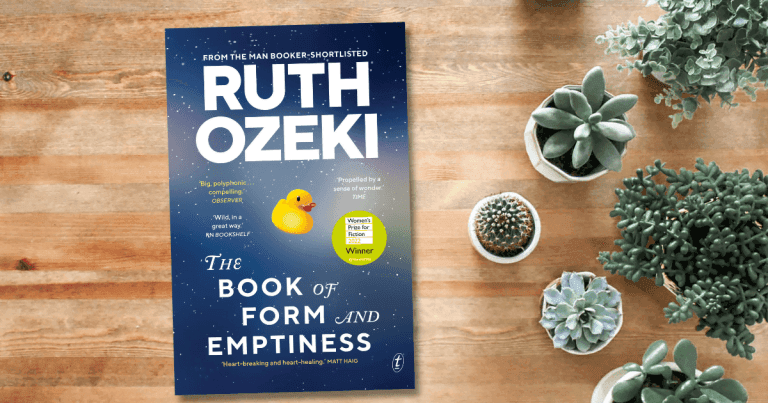
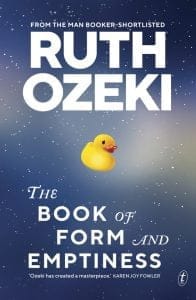
Ruth Ozeki won the prestigious 2022 Women’s Prize for this stunning story of grief, creativity and resilience. Let’s revisit our review here…
After his father dies, Benny Oh finds he can hear objects talking: teapots, marbles and sharpened pencils, babbling in anger or distress. His mother, struggling to support their household alone, starts collecting things to give her comfort. Overwhelmed by the clamour of all the stuff, Benny seeks refuge in the beautiful silence of the public library.
There, the objects speak only in whispers. There, he meets a homeless poet and a mesmerising young performance artist. There, a book reaches out to him. Not just any book: his own book. And a very important conversation begins.
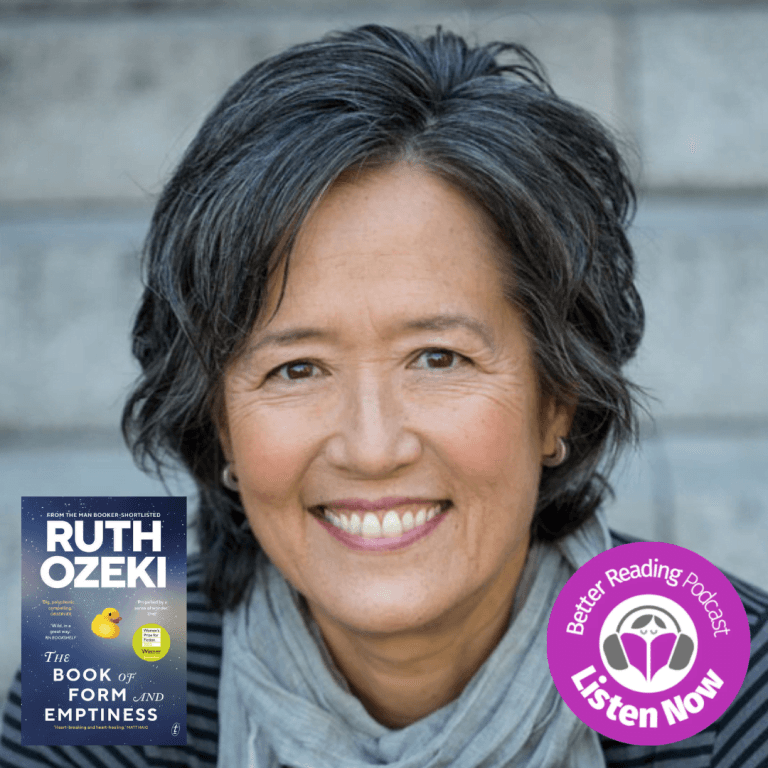
Ruth Ozeki is a novelist, filmmaker, and Zen Buddhist priest whose books have garnered international acclaim. Her first two novels, My Year of Meats and All Over Creation, have been translated into eleven languages and published in fourteen countries. Her third novel, A Tale for the Time Being, was shortlisted for the Booker Prize and has been published in over thirty countries. She has earned herself a reputation as a brilliant and inventive storyteller whose works integrate themes of science, technology, religion, environmental politics and global pop culture into hybrid narrative forms. Now she returns with her fourth novel, The Book of Form and Emptiness, a highly original and illuminating story that examines loss, growing up and our relationship with things.
The novel is narrated by thirteen-year-old Benny Oh who begins to hear the thoughts of inanimate objects after the tragic death of his father, Kenji. Benny, a mixed-race kid of Japanese and Korean descent, is described by Ozeki as ‘a small boy and slow to develop, as though his cells were reluctant to multiply and take up space in the world.’ This small boy makes for an extremely captivating protagonist whose struggles with grief and mental illness are poignantly portrayed here.
Perhaps more fascinating than Benny’s ability to hear objects, is that the novel is partly narrated by ‘the Book’ itself. Ozeki cleverly breaks the fourth wall by allowing the Book to narrate part of Benny’s story – often the parts he’d rather not discuss, like his parents’ sex life or his experiences with bullying. This playful and highly original take on narration allows Ozeki, through the mode of the Book, to ask questions about the act of storytelling itself: what is a story? How are they told? And who gets to tell them?
The Book of Form and Emptiness is about grief, resilience, creativity and psychological difference. It is about the importance of reading, and an observation of the mess consumer culture has got us into. It is an affirmation of the power of community. It is funny, kind, wise, urgent and completely irresistible.
With The Book of Form and Emptiness, Ozeki has delivered an ambitious feat of a novel that pushes the boundaries of what a novel can do, while also blending a heartfelt coming-of-age story with a touching exploration of mental illness and grief. But above all, The Book of Form and Emptiness celebrates the power of imagination and storytelling. Put simply, this is a book about books for people who love books.

Leave a Reply