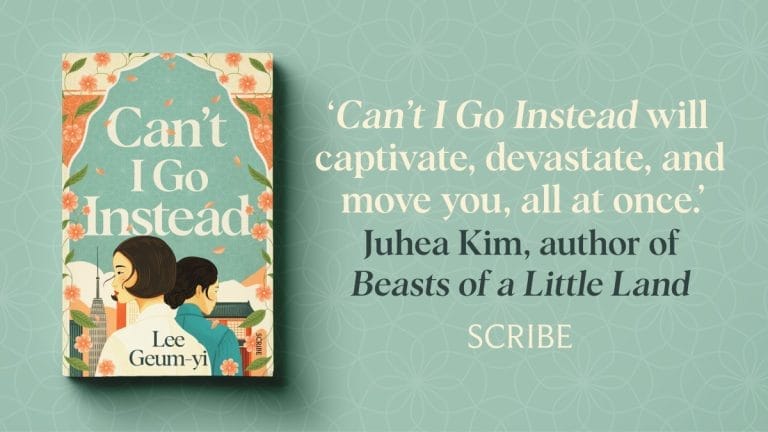
Two women’s lives and identities are intertwined – through World War II and the Korean War – revealing the harsh realities of class division in the early part of the 20th century.
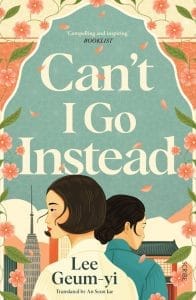
Can’t I Go Instead follows the lives of the daughter of a Korean nobleman and her maidservant in the early 20th century. When the daughter’s suitor is arrested as a Korean Independence activist, and she is implicated during the investigation, she is quickly forced into marriage to one of her father’s Japanese employees and shipped off to the United States. At the same time, her maidservant is sent in her mistress’ place to be a comfort woman to the Japanese Imperial army.
Years of hardship, survival, and even happiness, follow. In the aftermath of WWII, the women make their way home, where they must reckon with the tangled lives they’ve led, in an attempt to reclaim their identities and find their places in an independent Korea.
Can’t I Go Instead has touched me deeply and lastingly. What a profoundly beautiful, sweeping tale this is. It takes hold from the opening pages as Lady Gwak’s labour pains commence. Through this scene, we’re given an insight into her relationship with her nobleman husband and the world she is delivering her daughter, Yun Chaeryeong, into.
Chaeryeong is born into privilege and is the centre of her father’s world. His son, Ganghwi – Chaeryeong’s half-brother – may be the heir, but it is Chaeryeong who has his heart.
When her father presents Chaeryeong with a peasant girl to take as her own servant as a birthday gift, the chosen girl declines and a young spirited Sunam steps forward, ready for adventure and a bigger life. What a fabulous premise that is, set against the backdrop of WWII and the Korean War.
Can’t I Go Instead is an epic tale of love, loyalty and romance. It explores the tangle of jealousy, as well as female and familial rivalry that occurs when love is too scarce, and power is too coveted.
It’s also a candid read. Lee Geum-yi, via the excellent translation of An Seon Jae, doesn’t hold back from the underbelly of our darker emotions, of the brutality of competition, the devastation of division and class, of the price one pays when one is not born of privilege. When you’re not the chosen one.
The plot is swift and riveting as the girls grow into womanhood, swap identities and deal with a complex aftermath. It’s an excellently crafted, fully engrossing read that had me enraptured. To explore the twists and turns of two exceptional lives over multiple countries and explosive historical events with such humanity is a gift. One that I’m grateful for. This is historical fiction at its finest.

Leave a Reply