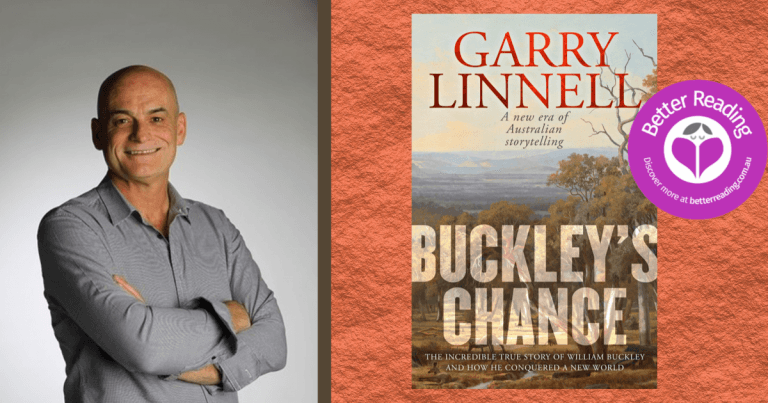
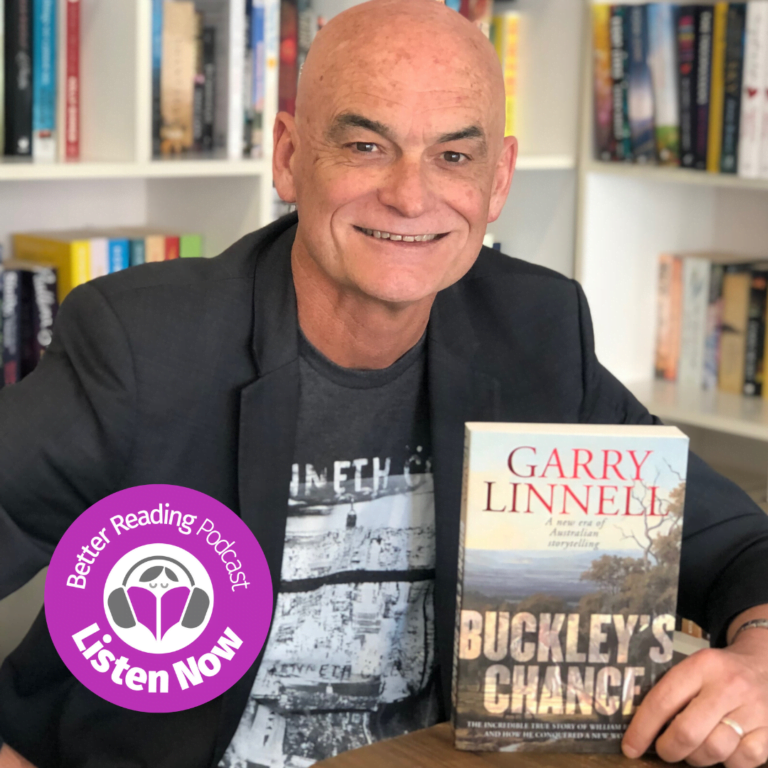
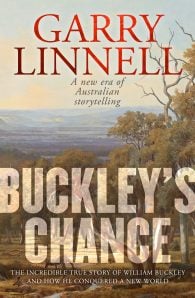
Buckley’s Chance is the incredible story of a man who refuses to be held down. Can you tell us a bit more about the book?
It really is an extraordinary tale. A young man escapes from the slow life in a rural English village and heads off to fight Napoleon’s army. A few years later he is sentenced to be hanged for stealing two small pieces of cloth. That sentence is then commuted to transportation for life to Australia. In 1803 he escapes from a small settlement near Sorrento in Victoria and disappears, given up for dead. Instead, he survives and is adopted by the local Wadawurrung people and lives with them for almost 32 years – the longest any European ever spent within an indigenous culture. When he returns to white culture just as the city of Melbourne is being founded, he is caught up in a race war and a ruthless battle of egos that leaves the countryside stained with blood and bodies.
When did you first hear about William Buckley?
I grew up in Geelong and he was always this shadowy figure from the past. As a kid I would visit Buckley’s Falls (a picturesque valley with cascading waterfalls) and could see the iron bars guarding the entrance to Buckley’s Cave at Point Lonsdale. I often wondered who he really had been – but we were never taught about him at school and everyone just assumed the tales about a man living with a local aboriginal tribe for so long was just a myth, perhaps a story cooked up by some imaginative tourism official…
Can you tell us about your research process for this book?
Much of it was spent going through hundreds of journals and documents looking for traces of Buckley’s footprints and people who met him, as well as interviewing experts in various fields, including the early colonisation of Australia and aboriginal history before the arrival of Europeans. Buckley was illiterate and we only have two significant pieces of work to rely upon with which he had some input. The first was an interview conducted with him by the reverend George Langhorne in 1837, and the other was a book written for him by a Tasmanian newspaper editor that appeared in 1852. Both are riddled with inconsistencies – and more than a little exaggeration in some instances – but they are also valuable source material.
What do you hope the reader will take away from this book?
Hopefully an appreciation for a man who was criticised as a simpleton – he was called a “mindless lump of matter” by one critic – but who overcame insurmountable odds. I think he was far cannier and intelligent than he was given credit for. He also had a deep and abiding loyalty to the First People and quite a remarkable amount of reverence – given the era and its shocking racism – for their rich and complex culture. If anything, perhaps it’s time we came to view William Buckley not just as the man who gave us the saying “Buckley’s Chance”, but who was one of the first true symbols of reconciliation.
You’re a columnist. How does this influence you while you’re working on this book?
I think it’s important to have several projects on the go. While researching and writing Buckley found me immersed in the first half of the 19th century – and despite its barbarity and cruelty I find it a wonderful era in which to get lost – writing columns keeps me focused on the present as well.
What’s your daily writing routine like and what are you working on at the moment?
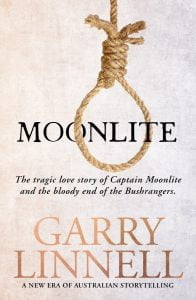
Routine? What routine? It just depends on the stage I’m at. If most of the research is completed then I like to be writing – or pretending to write while I stare out the window – pretty early in the morning with a steaming mug of black coffee next to me. Right now I’ve just started on a new book that covers the final era of Australia’s bushrangers. It’s a tale that looks at Australia’s coming of age as the nation emerges from almost a century of lawlessness. But believe it or not, at its heart is a very, very unusual love story. Now I’ve just got to write the damn thing….
About the author:
Garry Linnell was the Editorial Director at Fairfax, Editor of the Daily Telegraph and is a Walkley Award winner. 

Leave a Reply