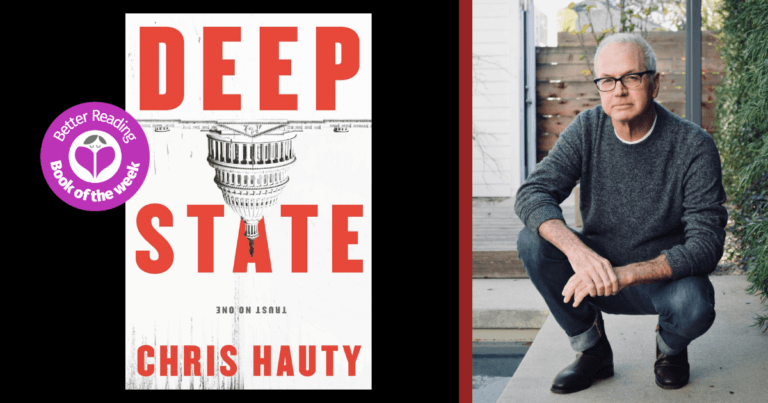
Deep State is described as an edge of your seat thriller. Can you tell us a bit more about the book?
When 25-year-old West Wing intern and ex-Army grunt, Hayley Chill, discovers the body of the White House chief of staff on his kitchen floor, a single clue suggests her boss has died from something other than natural causes. At increasing personal peril, Hayley begins to uncover shocking evidence of a wide-ranging conspiracy. Ultimately, it is the president’s life Hayley must single-handedly defend as the story hurtles toward its astonishing climax.
Deep State celebrates the near-mythic power of The One, placing its hero in a rarefied pantheon. Whether it’s a lone protestor standing defiantly before a convoy of tanks in Tiananmen Square, single mum Erin Brockovich taking on Pacific Gas & Electric, or David’s dust-up with Goliath, a lowly intern’s brave struggle to push back against a vast conspiracy resonates with our need for the unlikely hero. Stories like these make us feel like no foe is invincible.
What inspired the idea behind this novel?
I loved the movie Winter’s Bone and its central character, Ree Dolly, played by a very young Jennifer Lawrence. Ree is a 17-year-old woman with a sick mum and two younger siblings whose errant father has skipped bail. Problem is, Dad put the family’s West Virginia homestead up as collateral. If Ree can’t find her pop, the family is out on the street. She’s gritty, determined, resourceful and tough as nails.
At one point in the story, Ree Dolly considers enlisting in the US army; the family is desperate for the forty thousand dollars signing bonus. I wondered what would become of this fascinating, compelling character if she did join the army. What happens next? That’s where Deep State came from. Just asking myself a simple question like that.
What is something that has influenced you as a writer?
Unsurprisingly, movies have influenced me an awful lot. For the last four decades, I’ve probably watched three or four movies a week. I’ve always been a steady reader as well, though for much of my screenwriting career I was reading non-fiction.
My biggest fiction writer influence is Elmore Leonard. I don’t think it’s a coincidence that so many of his excellent novels have been adapted for film and television. His characters, worlds and stories are very much in my wheelhouse.
Before I started writing for the film studios, I lived in New York and pursued a playwriting career. I was heavily influenced by the playwright Sam Shepard. In college, I wrote poetry that was quite obviously influenced by Charles Bukowski. What these literary influences have in common I’m not quite sure, except they somehow ended up creating the writer I am today.
What’s your daily writing routine like and what are you working on at the moment?
I have an office at home, where you’ll find me between 8:30 am and 6:00 pm. With the imminent release of my first book, I’m working seven days a week.
My years as a screenwriter instilled a habit of careful outlining before starting an actual first draft. Writing that first draft is my absolute favorite part of the process. If I have a general idea of what happens next, I can relax and explore the unknown interiors of scenes and sequences, making cool discoveries along the way.
Currently, I’m finishing an edit of a follow-up to Deep State. The next book picks up about a year after the first novel leaves off. Story threads from the first book are followed and new ones are created. I love how this new book is turning out!
Deep State is your debut novel, coming from a screenwriting background. How did being a screenwriter help while you crafted this book?
One of Hollywood’s dirty little secrets is that people in the film and television business positively hate to read. No one really wants to read your screenplay, that’s why one of the lowest paid, bottom-rung jobs in the business is reading scripts! With that awareness in mind, very early on in my career I was determined to write in a way that made it easiest for people to read my scripts. Writing in a dynamic, clean and impactful way helped lower the barriers that face every screenwriter in Hollywood. That writing agenda applied across the spectrum of the endeavor, whether in terms of prose style, characterisation or narrative.
Keeping a reader engaged was a do-or-die proposition. I think those years definitely influence the way I write my novels. My goal is that you have to read me!

Hi Chris, I read Savage Road first, it was such a great read I went out and bought Deep State. I’m reading it at the moment. Quite exciting. Look forward to reading more of your books.
Give your feral cat a pat for me.
Cheers