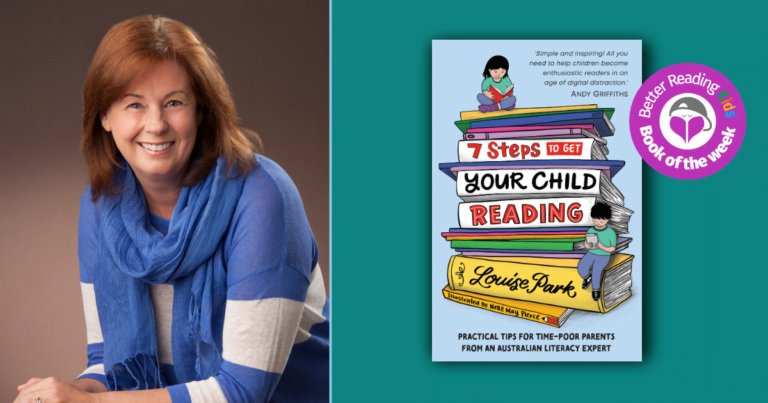
As an author and educator, you are in a unique position when it comes to understanding how to support children when they are learning to read. What is the most important thing you hope readers will take away from your book?
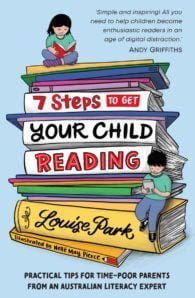
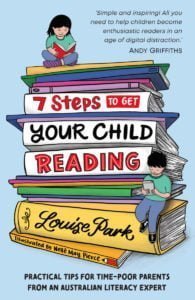
There are seven simple messages that can make a powerful difference to a child’s reading journey. If parents know what these are and how to incorporate them incidentally into a child’s day from birth it will make the entire literacy path that much simpler. I want readers to walk away knowing what these steps are and discover how easy and pain-free they are to implement. There is so much to be gained, so why wouldn’t you? I want parents and carers to know these secrets. Knowledge is everything.
As parents trying to encourage a love of reading in our children, how can we achieve this when it often appears that devices and books are pitted against one another?
The secret is not to see devices and books pitted against one another but rather aim to restore the balance between screen time and books in the home. There is nothing more important than this right now. In many homes the scales have tilted too far with devices. It’s the shiny bright thing, books are being left behind and literacy acquisition is taking the hit big time. The key is to give books the same level of importance and time in the home, if not more. To show children by sharing books with them, having books around the house, making time for books in their schedules and by reading books yourself, that books are to be treasured and enjoyed and are important, worthwhile experiences. Parents tell me that a computer game is better value for money because they play them again and again. Children will revisit their favourite picture books again and again too and it’s in that revisiting that the foundations for reading are being laid. It’s critical that books have at least the same profile in the home as technology.
If you need more convincing then know this: research tells us that having books in the home is twice as important as a parent’s education level in determining how far their children will go, and that they increase the level of education their children will obtain. Books are just so darn powerful.
What are the unique issues that the Alpha generation are having to tackle when they are learning to read?
Oh gosh, I could write a whole book on this . . . hang on, I just did!
Our Gen As (children born between 2010-2024) are the swiper, pincher, tapper cohort. The first generation to be born into a world of devices. The generation gurus tell us they are the group that will have the greatest digital literacy of any generation and the shortest attention spans and social skills as a result. So yes, they’re coming to the reading challenge from a unique position. I’ve already talked about the imbalance between technology and books. We know that books help children develop language skills, expand their vocabularies, give them ways to think about our world and develop critical thinking skills. They expand their worlds, fuel their imaginations, provide opportunities to develop empathy and to understand moral and ethical choices, and that’s just my starting list! Children arriving at school not having had enough experience with books will be behind those that have had. Research shows that children who start school with no or minimal literacy skills struggle to close the gap with their peers, and that the gap may continue to grow. Furthermore, they may never catch up unless they are identified and supported as early as possible.
But it’s not just the lack of books that’s changing the game, it’s the lack of writing by hand. Little fingers are not doing much gripping and scribbling anymore because they’re too busy tapping, pinching and swiping and parents aren’t aware of the detrimental effect it’s having on their ability to learn to read, spell and write. Reading and writing go hand in hand, they are the breathing in and breathing of literacy acquisition. Think about it: as children write and make letters, as they write and join these letters together to make words, as they write those words to make sentences, they are creating something they can read, because they wrote it. It’s their thoughts, their words, their spellings, their learnings—and all the while, they’re laying it down in their muscle memory and committing it to their long-term memory. This is crucial to learning to read and the message is clear: children who begin school with limited writing experience and too much reliance on screens are the group most at risk of falling behind in learning to read and performing at a standard year level.
There is so much more I could say here about the role of writing by hand and about the other issues Gen A have to tackle but the book covers them all.
We’re all told that we should be reading to our children each night and also listening to them read to us but children (and adults) have increasing demands on their time. What are a few quick and easy things we can do every day to help?
Here are a few tips:
- Take out a subscription to Story Box Library: storyboxlibrary.com.au It’s the most valuable site on the internet! Its educationally sound and created for children to view and hear quality picture books read by local authors. It’s the next best thing to having you read to them. So next time you just can’t carve out time to read for whatever reason, or just don’t have it in you for a read-aloud session, use this. It will be your lifesaver and will give them so much more than an electronic game ever could!
- Carry a book with you everywhere you go. Think about all the times you find yourself waiting with your child—at the doctor’s office, at the RTA waiting for your number to be called, even in line at the supermarket. If you’ve got a book in your bag, you can share it and kill time in a worthwhile way. I know Pinterest and the internet is filled with cool reading spaces in the home, ways to make reading at bedtime extra special, but the reality is that lives are busy and the location really isn’t that important. It’s all about the reading experience and finding ways to make that happen.
- Pat yourself on the back for all those days you manage to read as family or one on one and don’t sweat the days you couldn’t do it. Any exposure is good exposure!
What were some of the children’s books that made an impact on you when you were a child and why?
I’m a Zac Power author so you won’t be surprised to know that I was addicted to Nancy Drew and the Hardy Boys. I loved mystery, suspense and action. I also adored Pippi Longstocking, and of course, the Doctor Seuss books. They are so whacky! But the one I remember the most was an illustrated edition of Hans Christian Andersen’s Fairy Tales. It was given to me by my parents when I was in hospital recuperating from an operation. I was about seven years old and oh how I loved that book and its full colour plates. I couldn’t read it at first and had the stories read aloud to me. Later when I could read them, I did. That book gave me so much joy right up until I was about twelve. My favourite thing to do in later years was to trace or draw those gorgeous illustrations. It was the book that kept on giving and yep, I revisited it again and again and again.

Leave a Reply