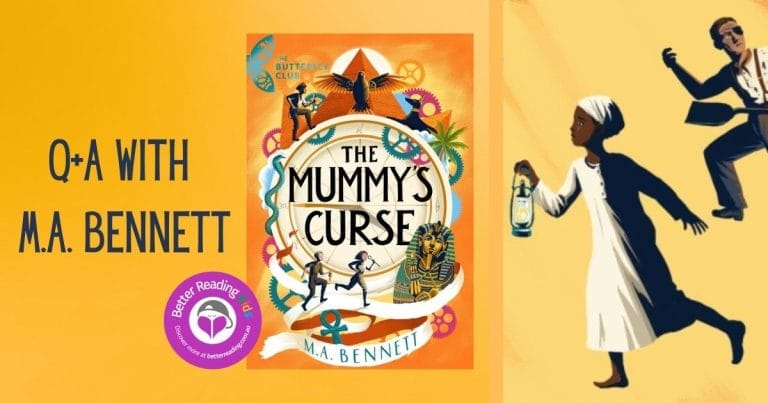
Briefly tell us about your book, The Mummy’s Curse
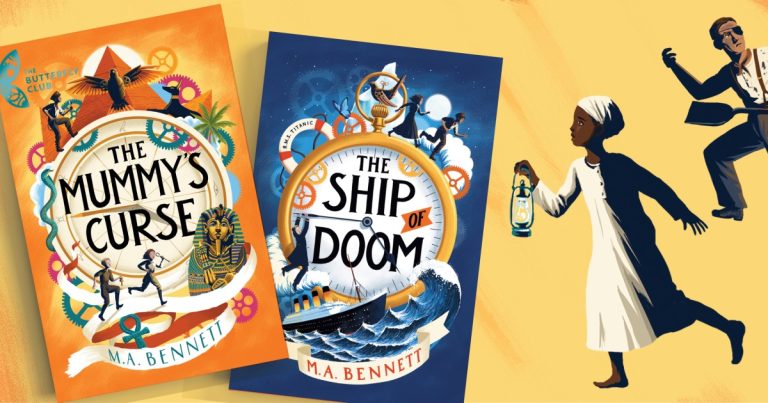
The Butterfly Club, a Victorian society that uses time travel to plunder the future for wonders, have their eyes on a shiny new prize. In Egypt, a man named Howard Carter searches for a lost king – Tutankhamun’s mummy, rumoured to be the greatest archaeological prize of all time. Together with her friends, Konstantin and Aidan, and a clockwork cuckoo, Luna Goodhart boards the Time Train. The gang travel from Greenwich, London in 1894 to Egypt’s Valley of the Kings in 1922 in a race to uncover the mummy first. With the aid of famed author Arthur Conan Doyle, the time-travelling thieves dodge tomb traps and solve temple puzzles to locate the long-dead pharaoh. But as it turns out it is not the time-thieves but Howard Carter’s waterboy, a twelve-year-old called Abdel, who stumbles on the top step of the long-buried tomb almost by accident. But when Abdel disturbs Tutankhamun’s 3000-year sleep he wakes something else too – a deadly and ancient curse. And now all the time thieves must face the terrifying consequences of their actions…
Who is your favourite character in the book?
Aside from my trio of main characters; Luna, Aidan and Konstantin, the real hook for me in the Tutankhamun story was the discovery that it was a twelve-year-old waterboy – Hussein Abdel Rassoul – who actually found Tutankhamun’s tomb first. Abdel’s mule stumbled on a long stone in the Valley of the Kings which turned out to be the top step of twelve, leading down into the most incredible treasure chamber ever found. Howard Carter himself recognised Abdel’s contribution to the find, awarding him with a priceless pectoral pendant from the tomb, made of gold and decorated with lapis scarabs as big as your fist. I thought Abdel would be such a good conduit into the story for a middle-grade reader, as a boy just their age made the greatest archaeological discovery of all time. And then of course you have the curse – there were so many stories swirling around about what the pharaoh would do to those who dared to disturb his 3000-year-long sleep, it certainly heightened the stakes!
Why do you think this book is important for the series’ progression?
The time thieves have already been to 1912 to witness the sinking of the Titanic, and now they’ve travelled ten years later to 1922 to see the excavation of Tutankhamun from the Valley of the Kings. The series takes as its subject very well-known events, but largely unknown heroes. Everyone has heard of the Titanic, but Guglielmo Marconi, whose wireless radio saved hundreds of lives on that doomed ship and countless lives over the following century, is unknown to many. Everyone’s heard of Tutankhamun, and most people think that he was discovered by Howard Carter; but not many young readers will have heard of Abdel Rassoul, a boy their own age, who was actually the first person to discover the greatest archaeological find of all time.
What’s some great advice you’ve received that has helped you as a writer?
I think when you are writing period novels you have to try to make a link between your young readers and your young characters, even though they live in different centuries. We all have things in common, whenever we live, and it’s about tapping into those same fears and feelings. I was given some great advice once by historical novelist Rory Clements. He said no one in history thought they were old fashioned; everyone thinks they are living in the most advanced and modern of times. So I try to remember that!
Where can we see the storyline headed next?
Next it’s the theft of the Mona Lisa from the walls of the Louvre Museum in The Mona Lisa Mystery. Again, Leonardo da Vinci’s painting is familiar to most, but many readers won’t realise that it wasn’t even famous until it was stolen. Of course, in my version of the story the time thieves are mixed up in the theft, and to help them carry out the heist they enlist the help of the one man from their time who is an expert at making things disappear – the fabled magician Harry Houdini.

Leave a Reply