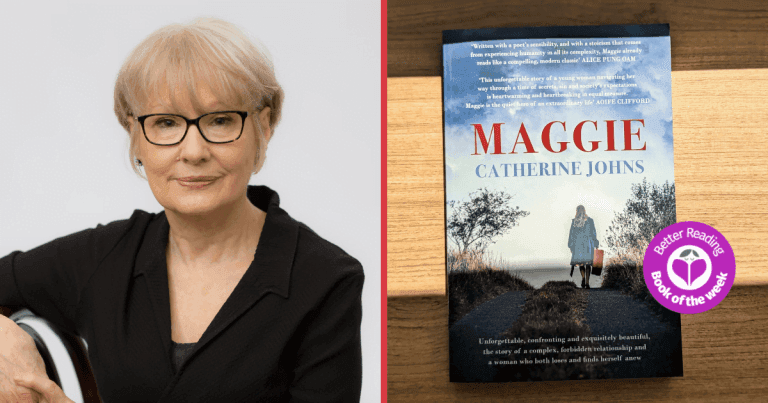
What do you hope readers take away from Maggie?
First, the satisfaction of having read a compelling story, not only about mistreatment and abuse, but about the power of friendship and compassion, and of the hidden strengths we find when in troublesome circumstances.
An understanding of what it’s like to be a vulnerable person in a relationship of unequal power, for someone of Maggie’s age, in all its complexity as well as its destructiveness.
Knowledge of the kind of power Catholic clergy enjoyed especially in the 50s and 60s: their absolute authority, which it was forbidden to question, and which made people like Maggie, formed inside this culture, and subject to abuse at home, more vulnerable to misconduct. The prestige the clergy enjoyed in the Catholic community, engendering a sense of entitlement which often led them to overstep acceptable boundaries, including sexual ones.
An understanding of the shame and isolation which unmarried mothers experienced in that era and of the lack of support that was available, many even being forced to have their babies adopted, inside and outside the Catholic system. From the 1950s to the 1970s, at least 150,00 Australian women reportedly had their babies taken without their consent by some churches and adoption agencies. This happened also in major hospitals.
A sense of Maggie as not so much a victim ultimately but as a whole person with an interesting inner life and a fighting spirit.
As much of the lightness in the book as the darkness.
Maggie’s story is set in the 1960s, what do you think has changed – or stayed the same – for women in Australia today?
I’m 73 and sadly I haven’t seen enough change. There’s more awareness of misconduct and abuse by priests, but the Church’s concern is still to protect itself above all else. The redress scheme is inadequate. More support is available, but not always enough.
I haven’t had anything to so with the Catholic Church as an adult, but I’ve heard from others that not enough has changed in terms of the power and prestige of the clergy, and their sense of entitlement. Celibacy is still compulsory. I don’t think attitudes towards women have changed there significantly.
There’s more discussion about consent in the wider community but there are plenty of contemporary cases where vulnerable girls like Maggie – and women too – are drawn into relationships with, and are assaulted by, men in powerful positions. Grace Tame’s story, and Brittany Higgins’ allegations, come to mind. And there are so many more whose voices haven’t been heard. Coming forward to report an assault in this context is still a fraught and risky business.
So the question of consent is still a huge concern. We hear more about power imbalances, but I think there’s a lot of cultural and political ground to make up to address this.
The stigma against unmarried mothers seems to have been largely removed, at least in the broader society, and I hope there are no more forced adoptions. But indigenous people might tell a different story about children still being separated from their families.
How would you describe the book in three words?
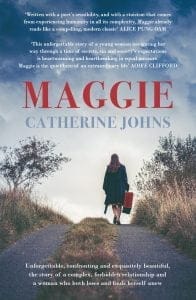
Maggie (the novel) in three words, is… ageless, confronting, transcendent.
What was your experience like writing the novel?
My experience of writing the novel was unusual. I have had ME/CFS (commonly and inappropriately known as Chronic Fatigue Syndrome) since 1981. It’s a neurological condition – It’s like long-Covid, also a post viral illness.) It has myriad physical symptoms and cognitive ones too. So fatigue, ‘brain fog’, difficulty concentrating and so on has meant I’ve often not been able to work at any normal pace. I did manage to write and have published a few short stories some years ago, and this helped me keep going. In the most severe stages I’ve been bedridden for a year or more. In the less severe ones the symptoms still make reading and writing quite challenging. So there have been periods of time when I couldn’t work at all, or so slowly that real progress seemed out of reach.
Sometimes after a long period of not writing I’ve had to reacquaint myself with the material and start again. An advantage of this has meant that I’ve written probably more drafts than usual, for example, in the third person, first person, third person again. Another one is that I’ve learnt from each of these and developed as a writer, and with maturity has come a better understanding of the themes and how to express them, and I think more technical prowess. So it’s been like writing many books but only one. This can be frustrating too. But the main thing was to finish it eventually and get it published, and here it is!
?I’ve been inspired by too many writers to count! Women and men and writers of all gender identities, Australian – indigenous and otherwise, and international. In my teens and twenties, before I became ill, I devoured books. Since then I’ve read more slowly and intermittently but at every chance, even one line or paragraph at a time when confined to bed. When I couldn’t read at all I listened to audio books whenever energy allowed.
Who are some authors who inspire you?
I remember reading Monkey Grip in 1977 when it came out: how I was inspired by the freshness and originality of Garner’s voice and style, and the territory her narrative bravely explored. I was inspired back then as well by other contemporary Australian women writers such as Kate Grenville and Beverely Farmer and Jessica Anderson and Amy Witting. Recently I responded similarly to Sally Rooney’s and Elizabeth Strout’s books: their unmistakable voices, their brilliance at storytelling, the timeless themes conveyed so vividly to contemporary imaginations. I’ve read all of Patrick White, Raymond Carver, Richard Ford, David Malouf…but the list is too long. Not to mention poetry…
The classics, too many to choose from! I’ve been inspired in some way or another by every writer whose work I’ve read, and I’m still learning from them.
Leave a Reply