Briefly tell us about your book.
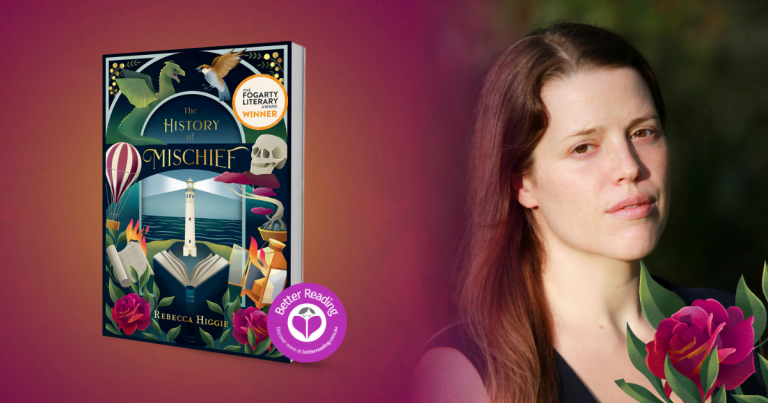
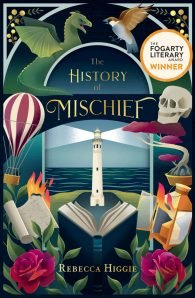
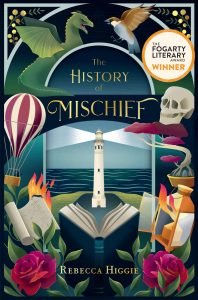
9-year-old Jessie and her 20-year-old sister Kay have recently lost their parents in a car accident. They move to their grandmother’s abandoned house in Guildford and there, under the floorboards, they find a mysterious book called The History of Mischief. The book spans over two thousand years, chronicling a mysterious magical power called mischief. It follows ‘mischiefs’ from Ancient Greece, Egypt, China, Poland, France, Ethiopia, Britain and Australia.
The mystery of the book, and where it came from, lingers with Jessie as she tries to navigate life without her parents. Inspired by the book, she starts to conduct her own mischief, surprising her new school friend and an eccentric elderly neighbour who vacuums her driveway at night.
The book won the 2019 Fogarty Literary Award and is out with Fremantle Press this September.
What was the research process like for the book?
I searched for every resource I could find: books, academic articles, souvenir guides, fictional accounts, radio programmes, documentaries, government reports, poetry, plays, memoirs, newspaper articles and quality online sources. I used my local library extensively to order books via inter-library loan, just like Jessie when she’s trying to discover the truth behind The History of Mischief. In fact, all of the books and research materials that Jessie references in The History are real!
Where possible, I also visited the places where the histories were set. For instance, I visited Augusta in Western Australia many times. I went to local libraries and historical societies to do research and went on multiple tours of the Leeuwin Lighthouse. I even snuck down to the lighthouse at night so I could see how the light worked (this was a bit mischievous, but I stayed outside the locked gates, promise!)!
I also lit a few books on fire. I needed to know what a burning book looked like. As far as research goes, that was quite fun.
How does it feel to hold your book in your hands?
It feels surreal. The History of Mischief took 12 years to write. I didn’t think it would ever be published. I still don’t fully recognise that the book in my hands in mine. The cover is so pretty. When I open it, it’s startling to see the words I wrote. It’s even a little frightening. I cannot change it now.
If I looked at your internet history, what would it reveal about you?
It would reveal that I am currently in the research phase of my next novel, as I am obsessively trawling through library catalogues and online second-hand bookstores in search of the obscure or out of print books I need. It would also show you that I’m a pretty good navigator (I look at Maps once and never use GPS) and that my entire life revolves around when my son sleeps (I am forever googling the opening hours of places).
If you could give one piece of advice to aspiring writers, what would it be?
Forget the rules. Write badly.
When I was at uni, a tutor told us to never use adverbs. Instead of ‘she said angrily’, show the reader how she said it angrily. The adverb is telling, not showing. From that point on, every time I wrote an adverb, I stalled. I scolded myself for indulging in bad writing. When I finally gave myself permission to use adverbs, alongside other forms of ‘bad writing’, I felt free. As much as the ‘show, don’t tell’ adage is useful, if you write with rules in your head, it can be difficult to move beyond the blank page.
I now think of writing as vomiting clay. You just need to get it out. You can sculpt it into something beautiful later.
Leave a Reply