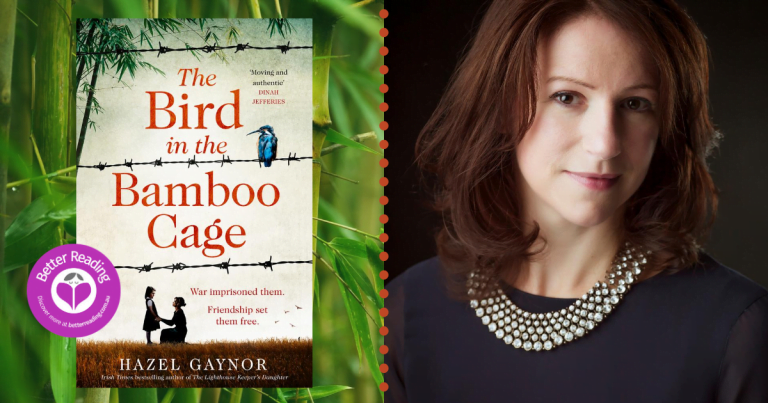
What inspired the idea behind The Bird in the Bamboo Cage?
The idea came from an episode of This American Life, a podcast in which I first heard about the incredible true events surrounding a group of schoolchildren and their teachers from Chefoo Missionary School in China, who were sent to a Japanese internment camp during WW2. What I hadn’t expected to discover during my research was a story not only of unimaginable hardship, but of extraordinary hope, friendship and kindness.
Can you tell us what the research process was like for the book?
I didn’t know much about the war in the Pacific, apart from vague memories of watching the BBC drama Tenko, so I first had to research the Sino-Japanese war, and the events leading up Japan’s declaration of war on Britain and the USA following the bombing of Pearl Harbor in December 1941. To understand the specific experience of Chefoo School, I went to SOAS (School of Oriental and African Studies), University of London, where the Chefoo school and mission archives are kept. I also found a website created by some of the Chefoo School children, who, as adults, have documented their memories. Stolen Childhoods, a book about the wider experience of children interned by the Japanese army during the war, was also incredibly helpful in understanding the emotional state of children separated from their parents, and of the adults who found themselves acting as their guardians.
If I looked at your internet history, what would it reveal about you?
You would definitely know I was a history nerd! I search for the most bizarre things while researching a book and often fall down historical rabbit holes! You would also see lots of cocktail recipes because I upcycled a drinks trolley during lockdown, and as I’m decorating our new home after a house move last October, soft furnishings are also a current obsession!
What are you hoping the reader will take away from your book?
I hope they will want to know more about the war in the Pacific and the internment of civilians across the region. It is an aspect of the war we haven’t seen written about much in fiction, and I hope readers will be eager to learn and read more. As with all my books, I ultimately hope readers will be deeply moved, possibly shed a few tears, but will close the book feeling hopeful.
For previously published authors, does the creative process get easier for you with each book?
No! This is my eighth book and it honestly feels like it’s getting harder! With a debut, there’s a certain amount of naivety and blind faith, but as a career builds, there is additional expectation from readers waiting for your next book. I always want each book to achieve more than the one before it, so there’s a natural sense of pressure I apply to myself. I absolutely love it though and always try to write the story I want to tell, and to be true to myself and those whose lives I have stepped into. I believe readers can feel an author’s honesty and passion on the page.
How does it feel to hold your book in your hands for the first time?
It is always a huge milestone in the publishing process and I love the traditional ‘unboxing’ ceremony! For so long, the book only exists as a Word document, or printed page proofs, so to see it come together with the finished jacket, cover quotes, and interior design elements is always very special. I try to take a moment to appreciate how far the book has come from the early seed of an idea, and then I pour a large G&T!
What was the most challenging part of writing The Bird in the Bamboo Cage?
The sheer scope and scale of the story, and the events surrounding it. I found it incredibly daunting at first. Also the setting, as China is a country I’ve not yet travelled to. I focused on the smaller everyday details of my character’s lives – fear, anger, love, hope, worry – the specific things that are important to them, even in the middle of an enormous global event. It is those small details and familiar emotions which readers today can relate to. We have a shared human experience that connects us, regardless of place or time.
How did you come up with the title for the book?
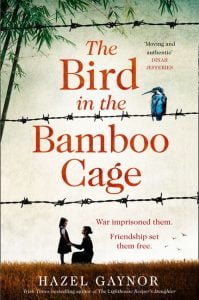
The working title was The Kingfisher Patrol (after the Girl Guide patrol in the book), so in my head that was the title for a long time. We discussed other titles but discovered they were already used by recent releases. I love the title we settled on. It really captures the sense of entrapment, and of place, and yet there’s a beauty to it. The cover design is perfect!
What is something that has influenced you in a major way as a writer?
Other writers continually influence and inspire me. At a writing workshop here in Ireland in 2010, when I was just starting out, I met Monica McInerney, who I know is a much-loved author in Australia. She was so incredibly kind and encouraging, and I often remember that. It meant so much to have support from a successful writer like Monica, and I try to do the same myself now and support new writers.
What are the easiest and most difficult parts of your job as a writer?
Easiest: Pouring the traditional glass of champagne on publication day!
Most difficult: Everything else!

What’s up to all, the contents existing at this web site are in fact remarkable for people experience,
well, keep up the good work fellows.