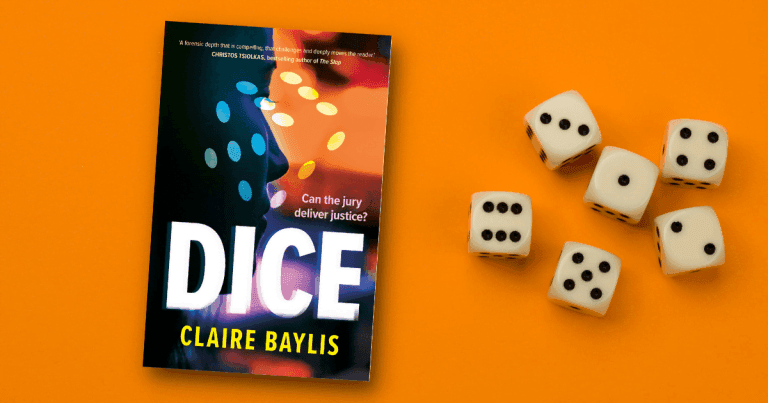
What inspired the idea behind Dice?
Some years ago I was offered a unique opportunity to be one of the interviewers on the Trans-Tasman Jury Study. I then conducted the first level of analysis of all the 45 trials (over 300 juror transcripts) for the New Zealand part of the study. In New Zealand, Australia and the UK it is very unusual to be allowed to talk to jurors about their experiences. During this research, I noticed how jurors sometimes had different perspectives of what happened in their deliberations and also how difficult some of the sex offence trials were for juries. I had always been interested in fiction where events were told from multiple perspectives, so it was a natural progression to write a novel about a fictional trial told from the perspectives of different jurors.
The age gap between my three children mean that I have now been the mother of teenagers for the last thirteen years, so writing about this age group navigating the difficult areas of consent and social media misuse felt very topical, especially after the Roastbusters case in Auckland.
How long did it take you to write Dice?
All up the novel took about seven years, but I had been involved in the jury research prior to this as well as undertaking more secondary research on some of the sexual offence cases during the writing of the novel. I first conceived of the novel in 2016 and applied to the International Institute of Modern Letters at Te Herenga Waka/Victoria University of Wellington to write Dice as part of a PhD in Creative Writing. I was accepted and began writing in 2017. My PhD was examined in 2021 and the novel was accepted by Allen & Unwin that year. The editing process took place mainly over the summer of 2022/23.
What are you hoping the reader will take away from reading Dice?
I tried to write Dice in a way that people can read it on different levels. On one level a reader can be part of the jury experience and work out for themselves what their verdicts would be and where they agree or disagree with the jury. On another level the novel explores some of the difficulties that sexual offence jury trials can raise so I hope readers might be left considering whether this is the best forum for dealing with these offences and if they think it is, whether any changes need to happen. The novel also explores some of the wider difficulties with the jury system in asking a group of strangers from diverse backgrounds to come together to judge their fellow citizens. At its widest level the book explores issues relating to power dynamics in society, social media regulation, intoxication, and sexual consent especially among teens.
What was the most challenging part of writing Dice?
There were two aspects of writing Dice that made it particularly challenging. First, I spent a lot of years researching sexual violence – from reading related fiction, survivor memoirs and academic research papers through to attending trials and reading trial transcripts and juror interviews. The subject-matter was tough, but I believed it was important work, and some of my research has been jointly published as a law article. The second challenge was inventing and inhabiting twelve very different characters while trying to ensure that they were all authentic and that each held their own narrative weight in the story.
The jury dynamics are a key part of the storyline in Dice. Was there any rationale behind who sat on the jury?
Yes, this was a very important part of crafting the story. In the novel, I was keen to explore both how the jurors’ life experiences and backgrounds impacted the trial and how the trial impacted their lives so it was very important who ended up on the jury. I wanted some of the characters to encounter different aspects of what can make jury service difficult to fit into jurors’ lives – for example, for parents who need to balance childcare demands, or for those who are self-employed or those who need to keep working while serving on a jury. I was also keen to explore how difficult some people find it listening and understanding the oral evidence and procedural and legal rules, as well as the potential triggering effect of some evidence for those with a traumatic background. I believed that jurors of different ages would respond very differently to the facts of the case, so that was another consideration. In addition, I was interested in exploring some of the dynamics that occur on any jury due to social and educational disparities between jurors. So, in some ways I was trying to set up the jury to be very divergent in their thinking, without falling into character stereotypes or tropes.
While bearing all these factors in mind, I wanted to create a jury that was representative of the people who live here in Rotorua, a provincial city with: a high population of Māori, many of whom are highly connected to their culture; a reliance on tourism and forestry; some areas of the worst socio-economic deprivation in the country due, at least partly, to colonisation, but contrasted with areas of high wealth, and overall a place where many people choose to live due to the beautiful natural surroundings of the bush, lakes and geothermal areas and Rotorua’s rich cultural heritage.
Given the content of Dice, did you ever consider writing under a pseudonym?
No, I didn’t. I felt it was important for readers to be able to read about both my academic background teaching and researching in these areas and my unique position having been involved in the jury research. In that way, readers could feel confident that I would treat this story carefully and respectfully. I want readers of Dice to know that the insights they gain into both the difficulties jurors face, and the misconceptions and prejudices that they may bring, are informed by my doctoral research which examined how juries made decisions in real sexual offence trials.
What did you edit out of Dice?
That’s a great question for me. For my PhD thesis I had to cut 10,000 words from the novel to ensure that it and the critical component ft within the 120,000 word limit. During the editing process I put about that many words back in, but they ended up being different words about different things!
I cut out some of the characters’ background stories, I simplified some of the charges against the defendants and early on I had some different jurors and a round of the Dice Game leading to a different offence – that of stealthing (the non-consensual removal of a condom before or during intercourse). I was keen to write about stealthing initially because it was becoming more widely recognised internationally as a crime during the writing of Dice, with the first successful conviction happening in New Zealand in 2021. However, it was important to make these cuts because I did not want the novel to feel contrived and I wanted to ensure it was a gripping read.

Leave a Reply