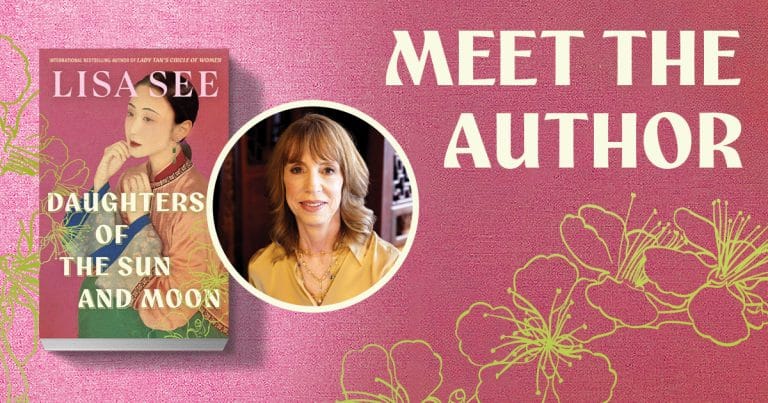
- Briefly tell us about your book.
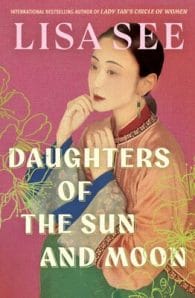
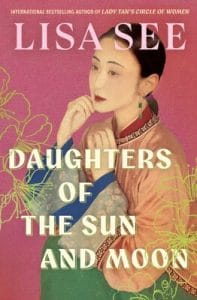
Daughters of the Sun and Moon is centered around a forgotten piece of American history—the Chinese Massacre of 1871. It follows three Chinese women, who were inspired by real women. Dove, the bound-footed daughter of an imperial scholar, journeys from China to Los Angeles to meet the older man her family has arranged for her to marry. Petal, the big-footed daughter of peasants, is sold by her father to a Los Angeles-based gang. Moon is the wife of a traditional Chinese medicine doctor. Despite the hardships each faces, Dove, Petal, and Moon forge an indelible bond against the backdrop of intense xenophobia and anti-Chinese sentiment typical of the time and that bears familiar themes to today. Brought together by destiny and bound by heartbreak, Dove, Petal, and Moon must use their resilience and bravery to endure in the face of tragedy.
- What inspired the idea behind this book?
In 1871, ten percent of the population of Los Angeles shot, stabbed and hung ten percent of the Chinese—18 men and boys—who lived in the city at that time. After the “Night of Horrors,” as it came to be called, politicians did everything they could to erase what had happened from the physical map and from the map of memory. Instead, they promoted Los Angeles as a place of abundant sunshine, good health, open land, tolerance, and endless possibilities. (All of which are still selling points today.) My great-grandparents—a mixed-race couple when it was against the law for Chinese and whites to marry in California—moved to Los Angeles in 1897, believing, correctly, that the city would be safer for them and their children. So, in many ways, the Night of Horrors is part of my family’s origin story.
- What was the research process like for the book?
Research is my favorite part of the writing process. I think of it as a treasure hunt. I never know what I’m going to find. And I love to go down rabbit holes. What was it like to travel on a ship from China to San Francisco—as a wealthy person or as someone in steerage? What was life like for the wife of a Chinese merchant in those days? What was day-to-day life like for a woman sold into the sex trade? What did women wear? How did they do their hair? What about makeup? Did they have bound feet, natural feet, or, like Moon in the novel, walk with a limp because of failed footbinding? What kinds of herbs and other treatments were used in traditional Chinese medicine to help a woman get pregnant, to prevent a pregnancy, to treat tuberculosis, to treat wounds? How did people get around? On horseback, by horse-drawn carriage, walking? In other words…Everything!
But nothing was more important to me than looking at the legal files from 1870-1871 that are held at the Huntington Library in Pasadena, California. Although some of the initial massacre records “disappeared” and many of the court documents were destroyed, the Huntington has preserved what has survived. All of this was written by hand in the 19th century. By the end of the day, I felt like a cartoon character with my eyeballs hanging down to my feet, but this was amazing material. I have on my website photos of some of the documents—including a map and also little drawings from a court reporter—so readers can get a sense of what it was like to look at these archival materials and what is in them.
- What are you hoping the reader will take away from reading your book?
First and foremost that they’ve had a good read! After that, I hope they’ll come away with a renewed appreciation for friendship—how we make friends, how they sometimes disappoint us, what they bring to our lives, and what we get from these deep-heart relationships. I hope readers consider the history of Los Angeles in its early days and how those roots can be felt locally, nationally, and even internationally today. And last, but hardly least, that readers will think about what was happening to the Chinese in America in the 19th century and more specifically during the Night of Horrors in Los Angeles and how those events relate to what many immigrants are experiencing around the world today. Can we learn from our mistakes or are we doomed to repeat them?
- If you could give one piece of advice to aspiring writers, what would it be?
Write 1,000 words a day, five days a week. At the end of a week, you’ll have twenty pages—a chapter. If you do it first thing in the morning, then you won’t get distracted by all the things that tempt you not to write.
Buy a copy of Daughters of the Sun and Moon here

geometry dash relies on a tightly integrated design philosophy in which music acts as both atmosphere and gameplay guidance
This is one of the better articles I have read recently. It answered several questions I had and even introduced me to a few ideas I had not considered before. Your clear writing style makes the content much more valuable. Thank you for creating such quality material. พิมพ์การ์ดแต่งงาน