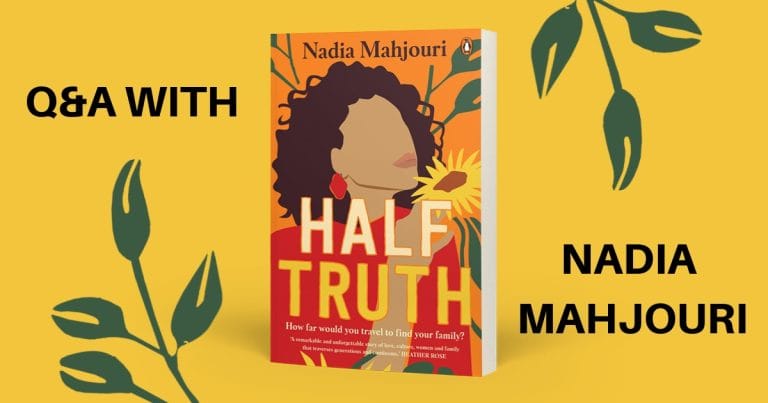
Briefly tell us about your book.
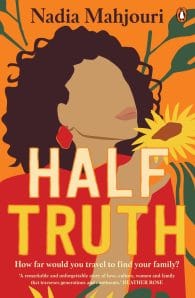
Half Truth is the story of two women who, unbeknownst to each other, are searching for the same man. Zahra – a 22-year-old Tasmanian new mother, is searching for her Moroccan father – a man her mother never discusses, and Khadija, an elderly Moroccan woman, who longs to see her first born son, Ahmed, who she hasn’t seen since the night someone tried, and failed, to assassinate the King of Morocco, twenty-five years ago.
What inspired the idea behind this book?
The book is inspired by my own life experience of travelling to Morocco to find my father. Like main character Zahra, I grew up in Tasmania with my mother and her white family and didn’t know anything about my Moroccan father. But in 1999 when my first child was born when I was 22, I felt drawn to learn more about my father and the country he came from. So I travelled to Morocco, with my new baby, to try to find him. But when I arrived, I discovered he hadn’t been seen by anyone in his family for more than twenty years. So,this is the beginning of the story which became Half Truth.
A second important inspiration was my desire to write about my Moroccan grandmother’s life. Unlike Zahra in the book, I never met my grandmother, as she had passed away two years before I arrived in Morocco but what I did learn about her – including her marriage at age 11 and the fact that she was 13 when she had my father – intrigued me and I wanted to get to know her better by writing her story.
What was the research process like for the book?
The research process for this novel was extensive and I had to use lots of different methods to get to know what it was like to be a village girl, born outside of Marrakech in the 1930s. Luckily, I have a background in academia and loved the process! Some of the research I did was speaking to my family and other friends in Morocco – including a friend who was an activist in protecting the Tamazight language, to reading novels written about this era written by Moroccan people, reading texts on Moroccan political history and accessing academic articles on various topics. Ironically, one important source of information for me were ethnographic texts by anthropologists who had catalogued Moroccan cultural practices and beliefs in the early 1900s – a such as Edward Watermark, and Francoise Legey. These texts, whilst needing to be read through the context of their authors’ cultural bias, nevertheless catalogued many of the religious beliefs and practices of the Amazigh people as they were at the time my protagonist Khadija was living in the village outside Marrakech, and so were a really useful source of information.
Additionally, having travelled to Morocco regularly over the last 25 years has also given me lived experience of how things change – occasionally for the better. For example, when the novel is set in 1999, the Tamazight written language was completely unrepresented in broader Moroccan society – now, in 2024 it is taught in government schools and road signs and the names of government buildings are written in both Arabic and Tamazight. So, a positive story for once!
What are you hoping the reader will take away from reading your book?
Oh, what a good question. I hope the reader comes away from the book satisfied – feeling like they have been on an adventure and experienced a life that is different from their own, but at the same time, identifying with the universal themes like motherhood, identity and belonging. I hope they feel connected to the characters and that perhaps, for those readers who have a parent born overseas and feel a little bit inside and a little bit outside of the culture of their parent(s) that they feel seen. And, most importantly, I hope that people come away feeling like they want to tell everyone to read it!!
Tell us about your background and what led you to writing this book.
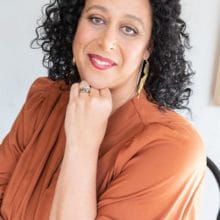
I am a mixed-race Moroccan woman who has been born and raised in Tasmania – on my mother’s side, I am related to the first white child born in the colony of Van Diemans Land, but on my father’s, I am first generation Australian!
I didn’t know my father growing up as they had separated when I was a baby. I grew up in Launceston in the 80s where cultural diversity was non-existent and I always felt that I stood out as I look like my Moroccan family and nothing like my fair skinned, blonde mother or my redhead stepfather. When my first child was born in the 1990s I decided to travel to Morocco to find my family so he knew more about being Moroccan than I had known growing up.
How does it feel to hold your book in your hands?
It’s a surreal and wonderful experience and I still can’t believe that it’s really happened. I absolutely adore the cover, so it makes me smile every time I see it. But also, it reminds me that even though it’s very much my book – it is the work of a team of incredibly talented people that have got it to this point and I feel very grateful they have trusted me enough to put so much energy into helping me to tell this story.
What’s some great advice you’ve received that has helped you as a writer?
The best advice I’ve received is that you need to learn to write – the craft is important, and it can be really useful to take courses and work with mentors. But, even more importantly, the best advice I have is what I would tell to others – which is the only way to be a writer is to actually sit down and write!!! It’s the easiest and the hardest part at the same time.
If you could give one piece of advice to aspiring writers, what would it be?
If you want to write, then you have to make it a priority. The only criteria for being a writer is that you write – and no – talking about writing isn’t the same as actually doing it! Even if you’re writing rubbish, at least at the end you can go back and make it better, but you can’t do anything with a blank page!
Who are some of your favourite authors? Or favourite books?
I absolutely love A Thousand Splendid Suns by Khaleed Hosseini and everything that Elif Shafak has ever written – but The Island of Missing Trees is a standout favourite of mine. I also love Holly Ringland’s The Lost Flowers of Alice Heart. I love to read books where I feel like I am in another country – where I feel like I can smell the air and taste the flavours on my tongue.
What’s your daily writing routine like and what are you working on at the moment?
I am working on book two which is super exciting but I’ve never been very good at having a daily routine, so I tend to work in bursts of hyperfocus in which I shut out the world and disappear into my own head for days on end. Thank God for my wonderful and longsuffering husband who is able to step in and keep out kids alive and our house habitable when I run off with my imaginary friends!

Amaing post. Keep sharing. Flappy Bird
Last winter, a massive snowstorm hit our area, and the weight of the snow caused some serious damage to my roof. I didn’t even notice at first, but when the ice started melting, I found water seeping into my walls. I was completely lost on what to do since I had never dealt with roofing issues before. A friend recommended Dennis & Team https://www.roofersnearme-ma.com , and they were a lifesaver. They did a full inspection, removed the damaged shingles, and reinforced my roof to withstand future storms. What I appreciated most was their honesty—no unnecessary upsells, just real solutions. If your roof has taken a hit from the weather, don’t ignore it. A small problem can turn into a costly disaster if you wait too long.
The fun of Paper io 3D comes from its simplicity. The more you play, the better you get at cutting off opponents and taking over the map. It’s so addictive!
https://www.betterreading.com.au/review/preview/your-preview-verdict-the-dagger-and-flame-by-catherine-doyle/
Accurately recognizes speech content. Upload audio, get fast transcription. No manual typing, just pure efficiency. Accurately convert Audio To Text