Tell us about your book.
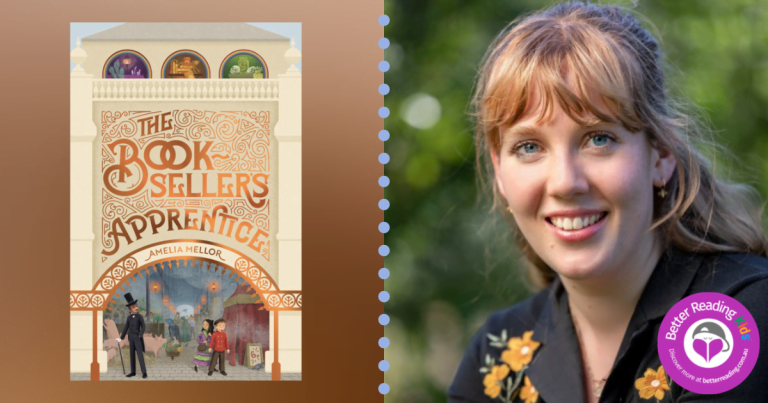
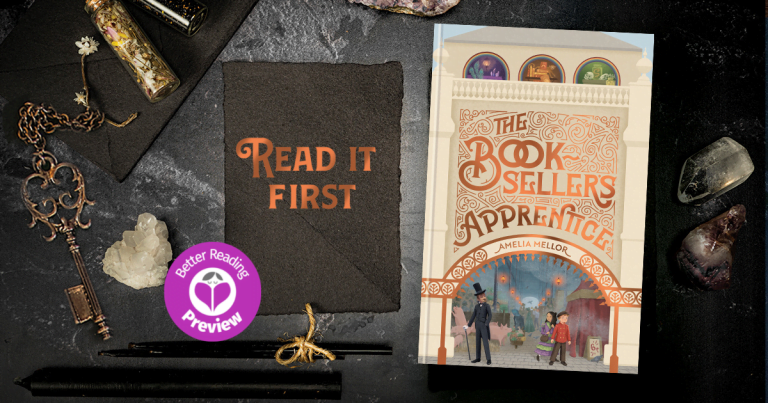
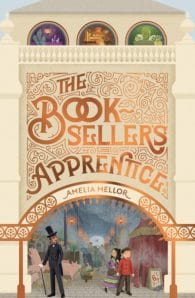
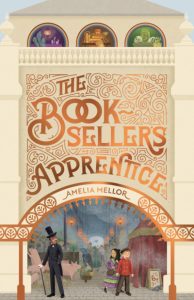
The Bookseller’s Apprentice is set twenty-two years before The Grandest Bookshop in the World. It follows a young version of Mr Pyke, the manager of Cole’s Book Arcade from the first book, who is called Billy as a child. In 1871, Billy is twelve years old, stacking shelves and serving customers for Mr Cole in a little stall in Paddy’s Market on Bourke Street. The market is this noisy, grubby, magical carnival full of people from all walks of life, and it seems like a dream job at first. When his friend Kezia warns him about a sinister con artist known as the Obscurosmith, Billy doesn’t want to believe her stories of magical deals gone horribly wrong. But he can’t deny the truth when he sees them happening – especially not when the Obscurosmith goes too far one night and endangers the lives of everyone in Paddy’s Market. And that’s when Billy realises that if no one else will try to bring the Obscurosmith down, he’ll have to do it himself.
So it’s a prequel, but it expands on the world and characters from the first book, much like a flashback scene within a story would do.
How did you go about developing your characters?
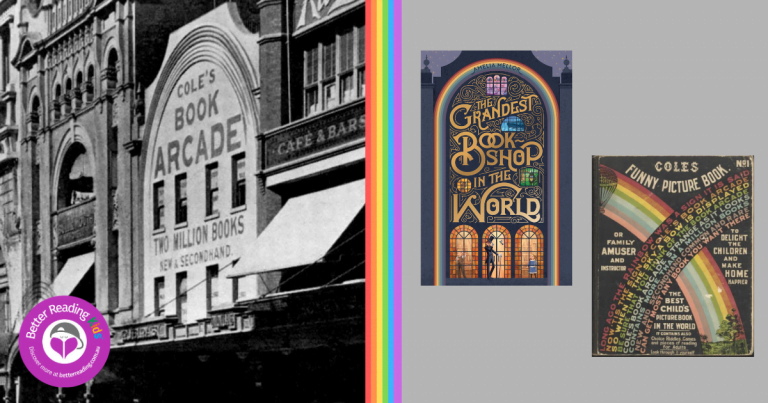
With this series, I look at my historical resources first and try to find clues to their personalities through what they wrote, or what has been written about them. Usually I sketch their bodies and outfits and facial expressions as well. Mr Cole was quite easy to figure out because he was such a prolific writer, and his deeds have been recorded quite thoroughly in several biographies. There are lots of pictures of him, too. Magnus – the Obscurosmith – also formed out of reading Mr Cole’s books. He’s the inverse Mr Cole: he’s intelligent in a cunning way, he’s playful in a cruel way, and he treats everyone equally badly. The way he talks came straight out of Cole’s Intellect Sharpener, which is full of tricky riddles. Billy is half based on the real William Pyke, whose diary and articles I read, and half created from my imagination. For instance, I was able to find out that he was the oldest of many children and born in a poor suburb, but I had to imagine his childhood home and how he might feel about his family. Some of the market folk, like Madam Zinga Lee and the Great American Painless Dentist, didn’t give me much more than a name and a gimmick, and I built their personalities out of that. Others, like Kezia, are completely from my imagination, and I just embellish them with fitting historical details. I had to get to know her through writing her.
Do you take inspiration from anyone you know for the invented parts of your characters?
I definitely do. For instance, in The Bookseller’s Apprentice, Billy tries to avoid having his feelings hurt by pushing people away and doing whatever needs to be done by himself. I’m guilty of that! He’s short-sighted like me, too. The kids at the primary school where I worked last year gave me ideas for his younger siblings, in terms of how kids of certain ages talk, play and think. Pearl from The Grandest Bookshop in the World is based partly on the real Pearl Cole, and partly on my sister, who is also the cheeky, enthusiastic, adventurous second-youngest of a large family. Even the Obscurosmith has a bit of me in him – I’m also a competitive perfectionist who loves wordplay.
Who is your favourite character in the book? Who are you most similar to?
I usually don’t have favourite characters as much as I have favourite character dynamics. Certain characters bring out different sides of each other that can make some scenes much more fun to write than others. My favourite dynamic in The Bookseller’s Apprentice is Billy and the Obscurosmith. Billy refuses to be intimidated by anything the Obscurosmith throws at him. They each want to knock the arrogance out of the other one any way they can.
I’m going to flatter myself and say that I’m probably most similar to Mr Cole, even though I didn’t really add anything of myself to him because he’s so strongly based on the real one. We’re both workaholic children’s authors with a passion for education and a wide range of interests, like science, art, gardening, and keeping unusual animals. Mr Cole had monkeys, parrots, and even a cheetah at one point! I have some funny-looking tropical fish.
Did you always plan to be an author?
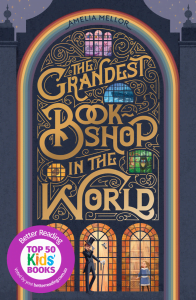
I’ve wanted to be an author since I was a toddler! I’ve always loved books and I used to get adults to read the same ones to me until I memorised them. I started writing in my spare time in Grade Three. By Grade Five, most of my lunchtimes were spent reading or writing. In secondary school, I was on the bus for an hour and a half every day, so I would write on my laptop on the bus. It must have been awful for my posture! Then I wrote the school play in VCE, studied creative writing at uni, and kept practising and improving and querying and getting rejected until The Grandest Bookshop in the World found a home at Affirm Press.
What’s some helpful advice you’ve received as a writer?
When I was a teenager, a family friend lovingly printed out about twenty pages of writing advice from Diana Wynne Jones for me. It included the phrase, ‘while you read and admire [a story you’ve written], you will come across bits that make you sort of squiggle inside and say, “I suppose that will do,” [which] is a sure sign that it won’t do.’ I think I rely on my internal ‘squiggles’ to guide my editing almost as much as I rely on the advice from my editorial team.
My VCE Literature teacher, the late Mrs McKay, also taught me how to analyse the machinery of writing in a way that gave me a deeper, richer understanding of both my own writing, and other texts I read.
What’s your advice to aspiring authors for young people?
My advice for any author is ‘practice as much as you can,’ but what you should practice depends on who you are and what you’re writing. Very young authors should practice using their imaginations, creating stories and figuring out what they like. Adult writers of books for kids should also practice seeing the world through a kids’ eyes. Try to focus primarily on what a child might enjoy or be curious about, rather than what you as an adult think is good for them. Something I’ve noticed about my books is that some adults fret about how scary they are, whereas kids in the right age group relish the spookiness because it’s exciting. Adults love the historical aspect and say ‘that’s so important for kids to learn,’ but I don’t think my books would appeal to kids as much if they were non-fiction or straight historical fiction. Put the child’s interest first, as Mr Cole would say, and they not only learn more quickly, but they enjoy the process of learning.
Buy a copy of The Bookseller’s Apprentice here.
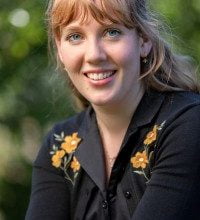
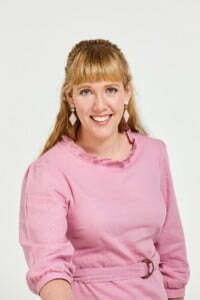 Amelia Mellor began her writing career as her secondary school’s resident playwright in Year 11. As part of her creative writing course at the University of Melbourne, she completed a thesis on the reinvention of the Industrial Revolution in children’s fantasy literature. Her debut novel, The Grandest Bookshop in the World, has won an Australian Book Industry Award, an Indie Book Award, a NSW Premier’s Literary Award and a Booksellers’ Choice Award. When she isn’t writing, Amelia enjoys hiking, gardening and drawing. She can be found at authorameliamellor.com or walking the streets of Melbourne.
Leave a Reply