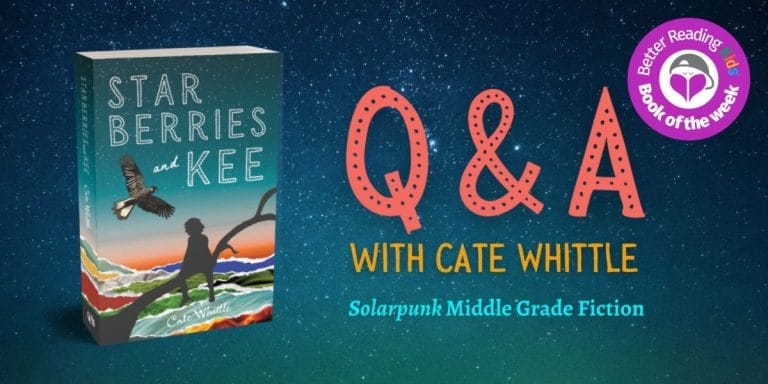
What inspired the idea behind this book and what are you hoping readers will take away from your book?
Every day there is more news about how climate change is having a devastating effect on our world and how we are racing towards (or have already passed) a point of no return – and it is becoming clear that this is causing a lot of anxiety for young people who (probably quite rightly) can’t see the adults in charge doing enough about it.
It is so easy to see a very dystopian future filled with cataclysmic weather events (we might be there already) and limited prospects for living a comfortable and predictable life. While I love a good dystopian novel as much as the next person, I wanted to write something that promised more hope – something that suggested that we can adapt and create a community-based, sustainable world. For this I went solar punk – at least for the setting, although purists will suggest that there is not quite enough anarchy.
I want my readers to be empowered by the story. I want them to see that there are small changes that everyone can make, every day, that will contribute to positive change. I don’t want to sugar coat it and say that we can stop climate change in its tracks – we have gone beyond that point and I think kids know it better than anyone – but that we can slow the damage down and we can create a future that is manageable and hopeful.
But, most of all, I hope that my readers will enjoy the adventure and fall in love with two very different but feisty characters.
How did you go about developing your characters?
My two main characters come from quite contrasting backgrounds but have the same great desire – for things to go back to the way they have been.
Hannah comes from a street community, a small group of people that have banded together to change their suburban homes into a self-sufficient locality with loose ties to other groups in their near vicinity. Technology is still used to tie them to a wider community and a shared responsibility for the welfare of all people, but it is focused less on a central government and more on boroughs.
Wren, however, is a wild child, brought up by someone who stepped outside of a society that was not responding to the need for change and gave up in frustration, leaving technology behind.
As characters, they are very much shaped by their environments.
I loved making them so different, but with the same ‘want’ to drive their stories, which collide dramatically and come to rest together, in their new place – their new environment.
Then there is Kee – a sulphur tailed black cockatoo – the cement in the story.
Can you tell us a bit about your writing process?
I’m what I like to call an intuitive writer – or a pantser – in as much as I never plan my stories tightly. This used to worry me until I realised that my first draft IS my plan – as one of my favourite writers, Terry Pratchett, once said, the first draft is just you telling yourself the story.
The one caveat is that I don’t start writing until I’ve spent a lot of time daydreaming and I usually have a reasonably firm idea about how I want the story to end.
While I’m daydreaming (often while out on long walks) I allow my characters to tell me about themselves, visualise my setting, and think up possible events or scenes. I usually have quite complicated conversations (in my head – mostly) with my new imaginary friends during this time and start to feel like I inhabit their world. I sometimes get some very strange looks from people I meet out on my walks.
For Starberries and Kee I spent a lot of time looking at my environment and thinking how this might be very different in the future, but what wouldn’t change.
How does this book compare to your other books?
I generally write fantasy and magic realism, and, while Starberries and Kee is very definitely speculative fiction, set in its imagined, solar-punk future, it has veered away from that fantasy element to try and present a possible future – a real and hopeful future – to which we can aspire. That said, is Old Man really there with Wren when he needs him most, or does Wren only imagine him there?
What advice would you give to aspiring Kids/YA authors?
There is so much advice I could give – but first and foremost, I would say to write what you enjoy or what you are most passionate about. Trust your story. And hang in there. The biggest attributes any author needs are to be patient, resilient, and determined. And to develop your writing skills. The easiest way to do this is to read, read, and read some more. Read in the genre that you write, but read outside your genre, too. I needed to try and learn more about solar punk before I could start writing Starberries and Kee, and this meant a lot of time online.
What’s next? Do you have any new spectacular stories you’re working on?
I always have several projects at different stages – not because I am an over-achiever (I am so not) but because my head is just so overstuffed with ideas it’s not funny and I have to make space somehow. At the moment, I am reworking a middle grade fantasy where the past and present are converging as a girl comes of age and learns about a family curse and her unusual powers; researching the history for a story I started to write as part of a challenge and discovered ten thousand words in that it wanted to be a different story to the one I thought I wanted to tell; I’m prepping (very slowly) my out-of-print Trouble books to be republished under my own imprint; and I’m waiting with bated breath for the next load of edits from Scholastic for a new junior fiction series about a little dog. I’m not sure, yet, whether there is any more to Hannah and Wren’s story.
Can you give us an outline of the story and characters?
Wren is a Wild Child who has been brought up on the mountain by Old Man, learning everything he knows from nature, while Hannah has always lived in the city.
Both are forced to leave what they have always known and loved to start a new life in a different place, and neither are happy about it.
An accidental meeting begets a secret friendship that brings a family full circle, linking the past to the present and the old with the new – but not without some adventures along the way, and a near disaster that almost brings a very different resolution to their story.
How did you think of the title of the book?
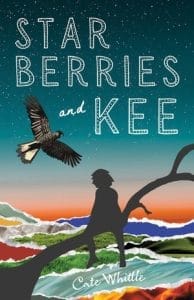
Starberries and Kee is a play on words – strawberries and cream – and represents, well, something good, a treat. It came from two elements that become very important in the ending of the story.
Kee is the name Wren gives his rescued black cockatoo friend – not quite a pet, but still very much a part of his life – and represents the sound these beautiful birds make.
And starberries? You might just have to read the story to work that one out.

Leave a Reply