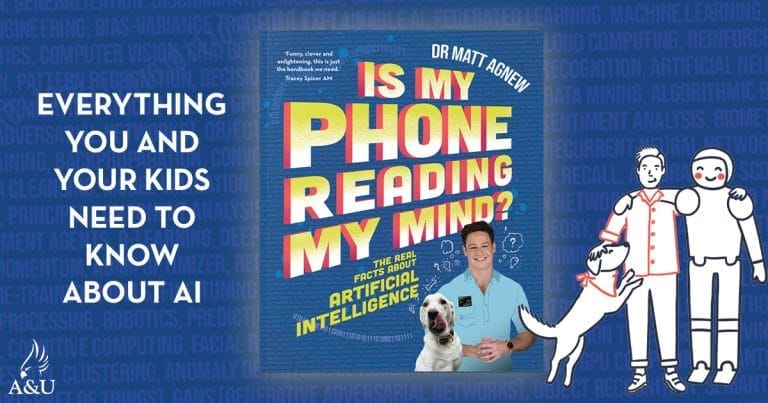
What’s the book about?
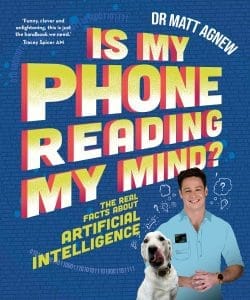
Let Dr Matt explain everything you and your kids need to know about Artificial Intelligence and why you don’t need to be afraid!
When you think of AI, you might imagine a walking, talking robot or you might think of a giant computer that wants to take over the world, but the reality is that AI is a brilliant human invention that can be found in nearly every modern device from our computers to our cars.
AI can seem scary at times, so working out where we use AI and why is an important part of making the best of this exciting technology. So, what is an algorithm and can it help you choose pizza? Can ChatGPT do your homework? And when you watch TV, is it watching you back? All these questions and more about AI are answered in a fun, funny and engaging way.
Recommended for:
Ages 8+.
Three reasons to read it:
- Matt, with his background in Astrophysics and Artificial Intelligence, presents a clear explanation of Artificial Intelligence (AI) and breaks down complex concepts into digestible information for kids. This makes the book a great introduction to AI.
- The book promises to tackle serious topics like algorithms and AI’s presence in everyday devices in a funny, and engaging manner. By using humour and relatable examples, Dr Matt makes potentially intimidating subjects approachable for young readers.
- Matt is passionate about making STEM (Science, Technology, Engineering, and Mathematics) accessible to everyone. Through Is My Phone Reading My Mind?, he aims to educate readers about AI’s benefits and dispel common fears associated with it. By understanding the basics of AI, readers can develop a more informed perspective on technology and its impact on our lives.
Buy a copy of Is My Phone Reading My Mind? here.
About the author:
 Dr Matt Agnew is more than a scientist and a self-confessed nerd – he’s a communications powerhouse making STEM fun and accessible for everyone. With myriad appearances across media channels, and a social media profile with a wide and varied audience, Dr Matt is a passionate and engaging scientist who has worn many hats – as an engineer, an astrophysicist, and an artificial intelligence expert – and has become a popular commentator on the latest happenings in the world of science. Dr Matt has a Doctorate in Astrophysics and a Masters in Artificial Intelligence, and is one of Australia’s leading ‘edutainers’. He was born in Adelaide, raised in Perth and now lives in Melbourne with his dog Pluto.


This sounds like a fascinating read, especially with how much technology influences our everyday decisions. It’s always interesting to explore different perspectives on digital privacy and human behavior. I also found some useful information while browsing https://gulfcountypropertyappraiser.org which offers a different kind of insight into public information. Thanks for sharing this book recommendation and I’m adding it to my reading list!
Interesting take this book sounds like a fascinating mix of science and curiosity about how our minds work. Topics like this always make you question how much technology really understands human behavior today. While exploring similar informational resources I came across https://hardeecountypropertyappraiser.org which also highlights how data can be organized and accessed in a structured way. Definitely a thought provoking discussion that encourages readers to look deeper into both science and information systems.
This post really highlights how fascinating the book is, especially the way it connects technology with human behavior. The idea of understanding whether our devices influence thoughts is genuinely thought-provoking. For those who also explore legal and public information systems https://fortbendcountycourts.org can be a helpful resource to understand related records and updates in a structured way. Overall, it’s interesting to see how both science and information systems shape the way we interpret the world.
Thought provoking points around Dr. Matt Agnew’s book especially how easily technology can feel like it’s influencing our thoughts. It’s interesting how everyday digital interactions quietly shape the way we interpret information. For readers who also explore structured public record systems https://fairfaxcountycourts.org can serve as a helpful reference for understanding organized case information. Content like this really highlights how science and real-world data often intersect in surprising ways.