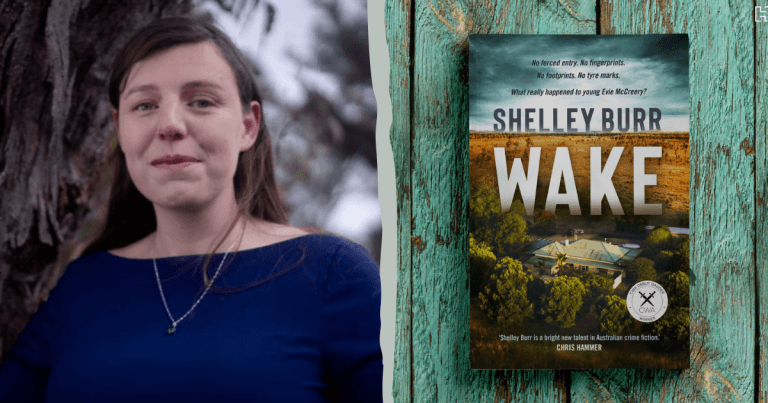
Briefly tell us about your book.
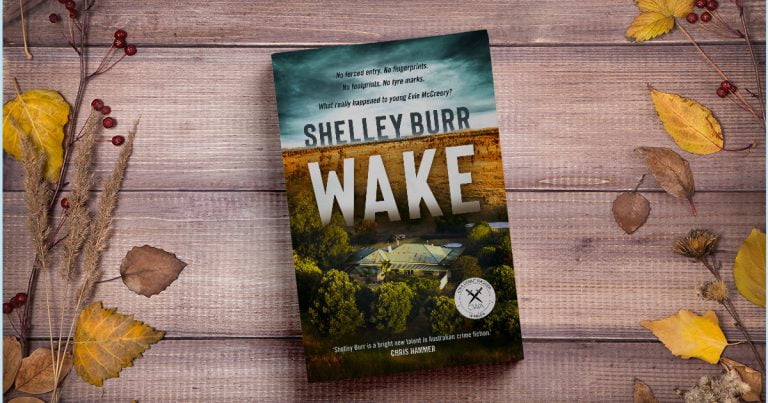
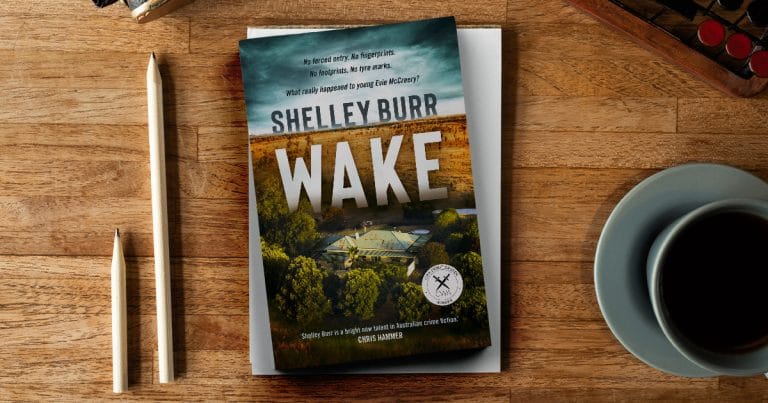
WAKE is the story of Mina McCreery, whose twin sister Evelyn disappeared from their shared bedroom when they were nine years old. The case was a media sensation, and remains unsolved despite a record-breaking reward.
Now an anxious and reclusive adult, Mina lives alone on her family’s destocked farm in central NSW. She is approached by Lane Holland, a private investigator who wants her help to reinvestigate the case. But Lane has his own secrets and obsessions relating to Evelyn’s disappearance.
What was the research process like for the book?
There were two types of research – deliberate and accidental. WAKE took four years from beginning to end, so often I would stumble across something in a non-fiction book or documentary that I was reading/watching for fun, or for work, that would end up in the story.
I read a huge amount of non-fiction to research WAKE. Xanthé Mallett’s Cold Case Investigations, Justine Ford’s Missing You and The Good Cop, Patrice Newell’s Who’s Minding the Farm? and Fred Brophy’s The Last Showman were influential.
I tried to stick to Australian sources, but Deborah Halber’s The Skeleton Crew, Michelle McNamara’s I’ll be Gone in the Dark and Tara Westover’s Educated had an impact.
I also did some research in the National Library of Australia, including reading back issues of a missing persons magazine to get a feel for how those cases were handled in the late 90s. I had an eerie experience doing that, as I started to notice a lot of ads for backpackers who had gone missing in the same area. Eventually I realised I was looking at the missing persons posters for the victims of Ivan Milat.
If I looked at your internet history, what would it reveal about you?
Most of my search history is taken up by increasingly specific recipe searches as I try to zero in on what I want for dinner.
Crime writers often joke about how suspicious their search history is, but I’m not worried. I hold a security clearance, and the last time I had it reactivated I had to give permission for my ‘internet footprint’ to be checked. That week my internet use included searching for signs of hidden/buried bodies, the method for having a missing person declared dead in Australia, and whether a wife automatically inherits everything if her husband dies without a will. I also spent hours on Google Maps, scrolling around remote areas and zooming right in on satellite view, like one might do when looking for a good place for a clandestine burial.
I got the clearance.
Also my husband is fine.
Who are some of your favourite authors? Or favourite books?
At the moment I’m on a poetry kick. I’m in the middle of Jazz Money’s knockout collection How to Make a Basket, which I picked up at Adelaide Writer’s Week. I also loved Evelyn Araluen’s Dropbear. Next I’m going to start Scott-Patrick Mitchell’s Clean.
I read a lot of Australian crime fiction. There is so much wonderful work out there that it’s tough to keep up with it all. I love Jane Harper, Chris Hammer, Jack Heath, Mark Brandi, Peter Papathanasiou, I could keep going.
My favourite author of all time is Terry Pratchett. I own multiple copies of Good Omens, and half my shelf space is devoted to the Discworld.
Are you able to switch off at the end of a day of writing? If so, how?
When I’m mulling over a scene, bits of dialogue or description tend to repeat in the back of my mind, I need to get them onto the page to let go of them.
If I set a goal before a writing session – a certain number of words, completing a particular scene, editing a chapter—and I achieve that goal, then I can walk away from my desk at complete peace.
If I meant to write a scene and instead I spent the session wasting time or distracted, then my brain will torment me about it later.

Leave a Reply