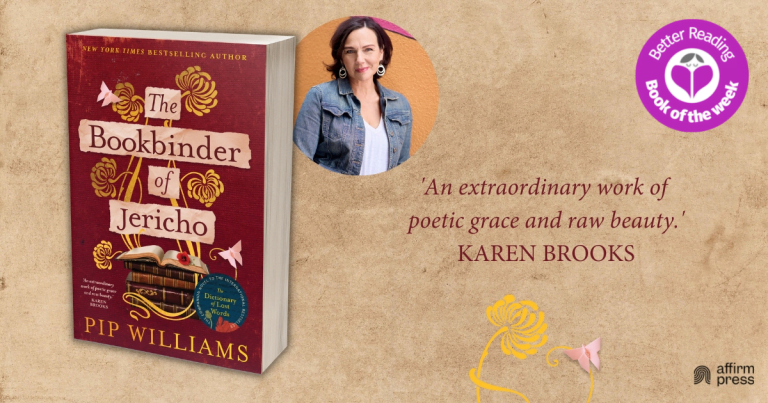
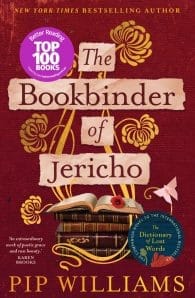
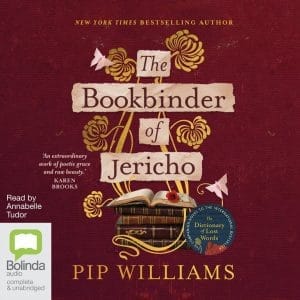
In 1914, when the war draws the young men of Britain away to fight, it is the women who must keep the nation running. Two of those women are Peggy and Maude, twin sisters who work in the bindery at Oxford University Press in Jericho. Peggy is intelligent, ambitious and dreams of studying at Oxford University, but for most of her life she has been told her job is to bind the books, not read them. Maude, meanwhile, wants nothing more than what she has. She is extraordinary but vulnerable. Peggy needs to watch over her.
When refugees arrive from the devastated cities of Belgium, it sends ripples through the community and through the sisters’ lives. Peggy begins to see the possibility of another future where she can use her intellect and not just her hands, but as war and illness reshape her world, it is love, and the responsibility that comes with it, that threaten to hold her back.
In this beautiful, sweeping novel, Pip Williams – the internationally bestselling author of The Dictionary of Lost Words – explores another little-known slice of history seen through women’s eyes. Evocative, subversive and rich with unforgettable characters, The Bookbinder of Jericho is a story about knowledge: who gets to make it, who gets to access it and what is lost when it is withheld.
If you have a curious mind and you’re a lover of books, you’ll absolutely delight in The Bookbinder of Jericho. It’s a love letter to books, in all their glorious physicality and humanness, and an absolute testament to the power of language.
What is lost when knowledge is withheld? The very best historical fiction gets us thinking differently about the world we live in today, and Williams certainly achieves that in this deeply affecting novel. Covering all the big themes – love, loyalty, loss, language and learning – Williams directs a contemporary gaze towards experiences that, like the women’s words in The Dictionary of Lost Words, have been largely overshadowed by history’s dominant narratives. In our current times, increasingly marked by inequality, war and uncertainty for refugees, it is more important than ever to reflect on what we can learn from the past.
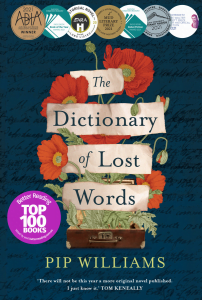
I must confess: when I was given a copy of The Bookbinder of Jericho to review, I had not yet read Williams’ much-acclaimed The Dictionary of Lost Words, which won the hearts of hundreds of thousands of readers with its refreshing and meticulously-researched exploration of the early stages of the suffrage movement. But Williams’ latest – billed as a companion to The Dictionary of Lost Words – is more than gratifying as a standalone novel.
I’m sure fans of The Dictionary of Lost Words will delight in the familiar names and strong feminist themes that pop up again in this novel, but the world is just as enchanting for those of us coming to it fresh. And lucky us – we’ll have another fantastic read to add to our TBR stack once we’re through with this one! I know I won’t be the only one deep-diving into Williams’ backlist after finishing The Bookbinder of Jericho.

Leave a Reply