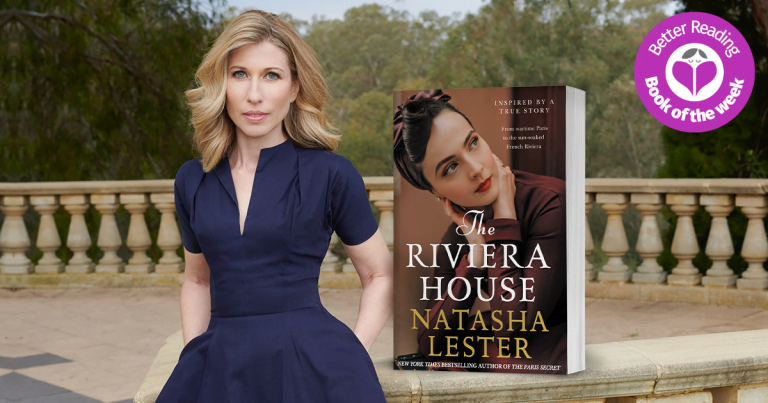
Briefly tell us about your book.
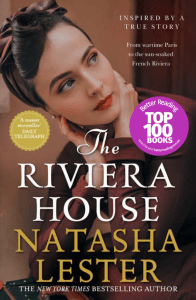
The Riviera House is a sweeping story of love, art and family secrets, inspired by the real people and true events of WWII. It’s told through the lens of art student and Louvre assistant Éliane Dufort. When war breaks out, Éliane is transferred to another Parisian museum to work – the Jeu de Paume – which is under Nazi control, guarded by armed soldiers. Behind its locked doors, Éliane finds thousands of precious artworks – a collection so impressive that even the best museum in the world would have trouble amassing so many treasures. She has no idea where the artworks have come from and why the Nazis have imprisoned them inside the Jeu de Paume. Thus begins a dangerous mission for Éliane – helping art spy and résistant Rose Valland to save these artworks from being taken to Germany and lost forever.
The novel also has a contemporary storyline about grief-stricken, Remy Lang, who flees to the Riviera to lose herself in her work as a vintage fashion collector. There, she discovers a catalogue of artworks stolen during World War II – including a painting that hung on her childhood bedroom wall in Sydney. You’ll just have to read the book to find out how the two storylines are connected!
What inspired the idea behind this book?
The Riviera House was inspired by two things – the Riviera itself and real-life Resistance heroine Rose Valland. Rose worked at the Jeu de Paume museum in Paris where the Nazis stored tens of thousands of artworks that they stole from Jewish families. She pretended she couldn’t speak German, but used her knowledge of the language to spy on the Nazis, recording the names of the stolen artworks and where they were being sent, even though she knew the Germans would kill her if they found out what she was doing. After the war, she was able to track down and restitute thousands of treasures to their rightful owners.
What was the research process like for the book?
Extensive and lots of fun! The research took me all over France, as well as through archives across the world. My journey began in Paris at the Louvre where I was able to search out some of the key paintings stolen by Hitler and Göring during WWII, including Vermeer’s Astronomer. I visited the Jeu de Paume museum next, which served as a clearing house for all the artworks the Nazis plundered. The National Archives in Paris holds numerous papers about the evacuation of the Louvre, as well as the detailed plan to keep them out of Nazi hands, which is another element to the story of The Riviera House.
From Paris, I set off for the Riviera, driving from one side to the other and eventually discovering the village of Saint-Jean-Cap-Ferrat, where the contemporary storyline of the book is set. Located in the village is the Villa Ephrussi de Rothschild and you can safely say that Remy’s Riviera house in the book is an exact replica of this villa. It’s such a beautiful part of the world: sea all around, secluded beaches, sweeping views of the coastline, and incredibly private houses occupying large tracts of land.
As well as the travelling, there was the far less glamorous but equally important task of sifting through historical records at the National Archives in Maryland, and the Musées Nationaux archives in Paris.
What was the most challenging part of writing this book?
As you can probably tell from my answer above, it was the length and breadth of the research process – the papers relating to the Nazis ’art pillaging during WWII are spread over thirty-five archives in ten different countries. Rose Valland’s memoir is only available in French, and I read through that very slowly, one chapter per day! I also felt an enormous responsibility to write about the theft of artworks – many of which are still missing – with sensitivity and respect. At times, I felt weighed down by how much there was to know, how much there was to say, the obligation I had to the people who suffered, and how on earth I would compress everything into a readable and compassionate story of fewer than one hundred and thirty thousand words. I hope I’ve succeeded!
How did you think of the title of the book?
Back in early 2018, I read a book called The Riviera Set by Mary S. Lovell. It was a narrative about American actress Maxine Elliott and her famous Chateau de l’Horizon near Antibes in France. I knew immediately that I wanted to write a book about a wonderful house on the French Riviera, a house with a complicated history, a mansion that might be resurrected and redeemed sometime in the future. But I didn’t yet know what story I would weave around this house nor who might occupy it. To find out, I wrote The Riviera House and named it in homage to Lovell’s book.








Leave a Reply