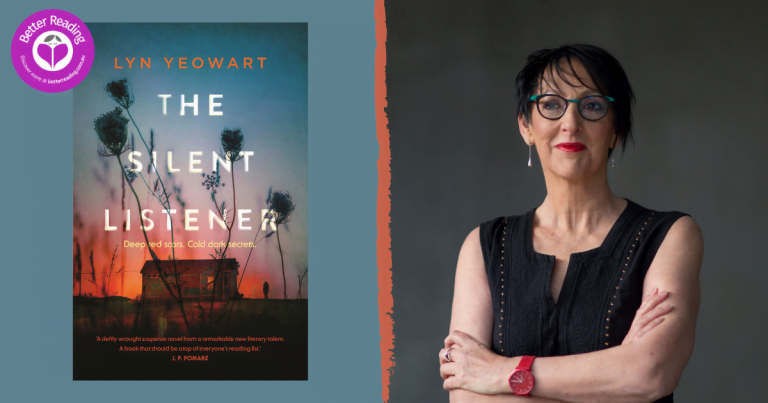
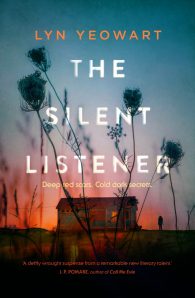
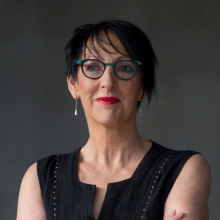
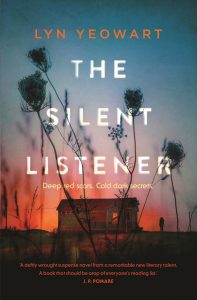
Tell us about your background and what led you to writing The Silent Listener.
I grew up with a violent and deeply religious father on a farm in Gippsland, where there were no books except What Bird Is That? and various versions of the Bible. At the end of High School, I managed to win a scholarship that gave me financial independence so I could go to university and study to become a teacher.
I had long harboured a secret dream to become an author but had absolutely no idea how I might go about it, nor the self-confidence to find out. In my early 20s, as a young teacher, I penned a few short stories (which, frankly, were terrible), and then left teaching after successfully applying for a job as a technical writer, where I wrote user manuals for software (they were massive tomes). I was quite chuffed that I was making a living from writing.
I enjoyed the work but wanted to broaden my range of writing skills, so I left that company and set up a business for myself, offering all kinds of business writing and editing services to corporate and government clients. A couple of blinks later and I had two teenage children, and the business was keeping the proverbial wolves from the door, but I still wasn’t doing any creative writing. I decided I had better get on with it or I’d regret it on my deathbed, so I started writing short pieces of writing again… and what came pouring out was scene after scene based on my childhood. Slowly they built up, and I liked some of them and showed them to a poet friend I was working with, and he said he was impressed.
A couple more blinks and I had a Post-graduate Diploma in Creative Writing, and a Masters of Creative Writing, but still no novel. I did have a lot of scenes, though, along with a few more characters, and quite a lot of compliments, including from lecturers Arnold Zable and Tony Birch. All those scenes were sitting in a folder on my pc, but still, I had no idea of how to become a novelist. What I was lacking was a story and a structure, something that would pull readers in and pull them along like a current: an overarching story that would keep readers interested in what was happening to Joy and her family and make them want to know what happens next. So I had to change how my brain was working when it came to my creative writing. Eventually, I hit on the overarching story (or stories, in fact, as I think there are essentially two in the novel), and I began the real journey to writing what was to become The Silent Listener.
How does it feel to hold your book in your hands?
It’s both wonderful and a little bit terrifying. I have a thousand thoughts about it that range from “I can’t believe I actually did this” to “What if people don’t like it?” There are also a lot of improvements that I wish I could make now, but I’m coming to terms with having to “let go” and accept that it’s as good as I could make it…in the time that I had…when I was the person that I was.
What is something that’s influenced you as a writer?
Like so many writers, reading has always been a source of delight and awe for me. I didn’t grow up in a house full of books, so books were very special to me when I was a child, and they still are. So every book I’ve ever read has influenced me and helped to shape the kind of writer I became.
Inevitably, many people have influenced me, but I’m going to restrict myself (with great difficulty!) to just two. Firstly, Deanne Weir, a philanthropist and media entrepreneur who I taught at Horsham High School in the 1980s. She’s influenced me because she quietly believed in herself and set about achieving massive goals without having it all given to her on a platter—and, arguably more importantly, without compromising her values or ethics. Secondly, JP Pomare, author of Call Me Evie and In The Clearing (and who I met in the first Novel-Writing MasterClass I did), wrote in an article that literary fiction was his passion and writing commercial fiction was his day-job. This single line suddenly gave me permission to play more with the plot and characters in The Silent Listener, and create a less literary piece of work. (Confession: I always thought I would write “highbrow” literature.) JP has also been single-minded about achieving his writing goals, and I’ve tried to adopt a similar singularity of focus.
Are you able to switch off at the end of a day of writing? If so, how?
I often write late into the night, and when I get into bed, I listen to podcasts that mostly have nothing to do with writing (I tend to listen to writing podcasts in the car and while walking). So the podcasts I listen to when I want to unwind are mainly of various Radio National shows, my favourites being Late Night Live, The Philosopher’s Zone, The Science Show, and All In The Mind. I like drifting off to sleep with mellifluous voices in the background (it’s like being read to sleep), but I often become engrossed in the discussions and want to stay awake to listen to the whole show.
What’s your daily writing routine like and what are you working on at the moment?
When Melbourne went into lockdown, three of my writer friends and I decided to have a daily Shut Up and Write session each morning, via Zoom. We did this every single day (weekdays and weekends), so now I wake up ready to write. We’re still holding the SUAWs but now that lockdown is over, it’s not as often and not everyone can be on every day.
So, in the morning I tend to write for an hour or so in the SUAW session, then get stuck into my day-job which is writing and editing for organisations and artists, and assessing and editing manuscripts for writers. I try to get in some exercise and some reading every day, but I confess I’m much more successful with the reading than the exercise. At the end of most days, I’ll head back to my computer again because I love writing in the deep of the night – there is a stillness and quiet that is reassuring, and when I’m wrapped in the darkness beyond the light of my lamp and pc, I feel I’m in a private little world, free of distractions, where my sole purpose is to write. It’s a beautifully peaceful time in which I think I create some of my best work.
I also like putting aside large blocks of time to write – a whole week, a whole month – because it not only produces quantity, but also quality. Writing in these large chunks of time means that I’m walking, breathing, eating, sleeping “the book” and ideas come thick and fast – everything from the rewrite of a sentence to make it stronger, to a-ha moments about the structure, and twists and turns that surprise me and (I hope) readers.
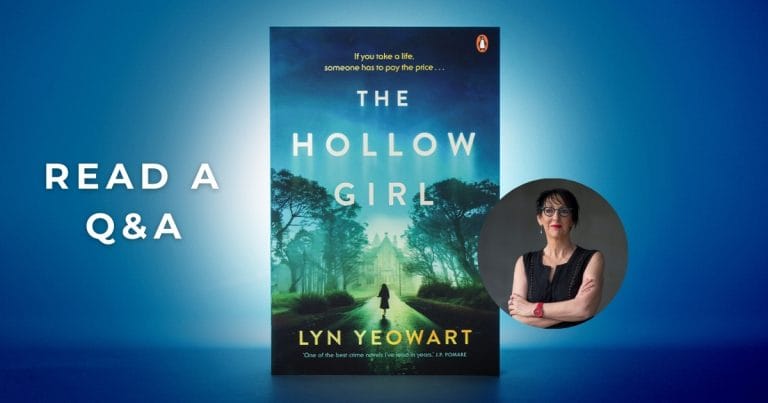
I’m currently working on my second novel that’s based on the lives of two people I know. Exploring themes of identity and medical ethics, it traces events during and after what became known as the Baby Scoop Era of the 1960s. It was a time when unmarried mothers gave birth in homes and had their babies quickly adopted (scooped up) by infertile couples. With a working title of The Lost Children of Harrowford Home, it weaves what I hope is an intricate web of deception and secrets.
Leave a Reply