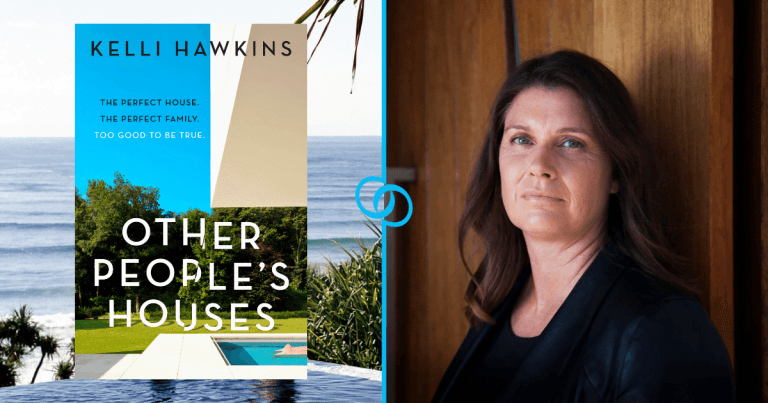
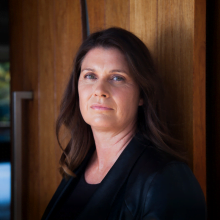
Read our Q&A with the amazing Kelli Hawkin’s. She writes for both kids and adults, juggles raising kids with writing, and shares here the bittersweet moment she held her novel, Other People’s Houses for the first time, in the wake of her husband’s death. Finishing any novel is a mammoth effort, let alone under these circumstances. We loved this novel, and hope you do too.
Briefly tell us about your book
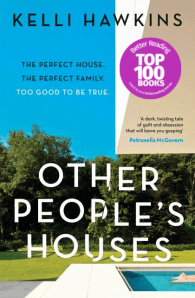
On the tenth anniversary of her son’s death, Kate Webb still grieves. Kate – a borderline alcoholic – attends open houses on Sydney’s wealthy north shore, imagining the lives of the families who live there and taking a memento from each one.
Then she visits the Harding house – the perfect house with the perfect family. Here, she finds a photograph of a kind-looking man, a beautiful woman she knew at university and a boy – a boy that for a heartbreaking moment she believes is her own son.
As Kate becomes obsessed with the Hardings, uncovering the sordid truths that lie beneath their glossy façade of perfection, she insinuates herself into their lives, grappling with her own demons as her world spirals dangerously out of control.
What inspired the idea behind the book?
A few themes and ideas came together to form Other People’s Houses. The central premise – that of an unreliable woman attending open houses and taking a memento from each one – came to me in the night (as writing ideas so often do!). I immediately wrote it down, as I am great at forgetting night-time ideas. My husband and I were selling our house at the time so I had real estate on my mind. I thought the idea had legs, but for a long time, it was just an idea. It took several years and many edits to get it publication-ready.
And as a mother of young children, I suppose the thought of something terrible – something unimaginably bad – happening to one of my kids was always in the back of my mind. I brought those two ideas together in Other People’s Houses.
If I looked at your internet history, what would it reveal about you?
Please don’t do that!
I actually think about this often, as research for a novel, especially a thriller, is so varied and usually falls somewhere on the scale from vaguely criminal to downright dodgy. For example, recent searches for my next book include witness protection programs, how to describe the feeling of touching fresh blood, how to get through customs illegally, PTSD, identity theft, the best country to ‘buy’ citizenship, where to bury a body outside Peterborough, and examples of blackmail by private investigators.
Then of course there are searches for character traits and interests or little things that you just need to get right. For me, that has included searches about Birkin handbags, how to calculate your pregnancy due date, the time the sun sets on 26 August, in Brighton, test cricket, comic book collecting, surfing and the best way to sand a tabletop.
And finally, I also write children’s middle-grade fiction (The School for Talking Pets, also with HarperCollins, is out in September) and for that book I’ve searched for the sound a guinea pig makes when upset, a blue-tongued lizard’s favourite foods, character traits of German Rex cats, Winston Churchill’s meetings with Albert Einstein and Furcifer belalandaensis.
Additionally, on my search history, there would be hundreds of searches for food and recipes. Partly because I just really like food and cooking, partly because people in my books always seem to be eating!
What did we do before the internet?!
How does it feel to hold your book in your hands?
In short, amazing. Scary too. For some reason the thought of people actually reading the novel now that it is out of my hands is terrifying.
I was one of those children who was always reading (I read while walking around the house or eating dinner, much to the annoyance of my mother!) and the idea of having a novel with my name on it on the shelf of a library or bookshop was pretty much the best thing I could imagine. But holding my first copy of Other People’s Houses was bittersweet too. My husband died less than six months before I signed the contract with HarperCollins after a sudden and unexpected terminal cancer diagnosis. Him not being there for that moment was difficult, as it has been for many other moments and will continue to be for so many moments in the years to come.
What’s your daily writing routine like and what are you working on at the moment?
My daily routine is varied but also kind-of not if that makes sense. If I am writing something new, I try to put my bum on the seat and get the words down while my kids (now teenagers) are at school. If I am editing, I will print out the latest version of the manuscript and go through it with a pen before getting back in front of the computer. I do most of my writing while the kids are at school but will work at night if I’m trying to meet a deadline. Marketing and promotion are still new to me, so at the moment I fit them in when they come up (and as an introvert, it is a struggle!). I try to walk every day as it allows me time to think about character and plot or something that might be niggling at me. Plus, I just need to get out of the house sometimes.
At the moment I have just finished the first draft of my second adult book. So I’ll give myself a break for a few days and wait to see what my publisher thinks of it before starting the editing process. But in the back of my mind, I am also starting to plan for my second children’s book, which needs to be written this year. Two wildly different types of books, so I need to try to focus on one genre at a time. Compartmentalising is key!
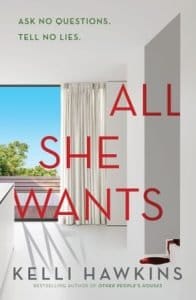
Absolutely loved Other People’s Houses and wondering when your next adult fiction book will be available?
I have just finished reading your book (other People’s Houses) and absolutely loved it,
Thanks so much