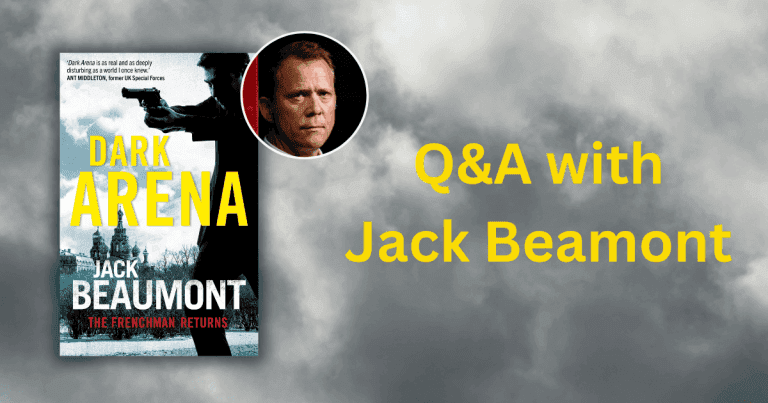
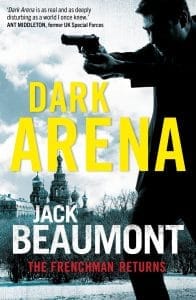
Briefly tell us about your new novel, Dark Arena.
Alec de Payns is an operative in the secretive Y Division of the French foreign intelligence service, the DGSE. When the French government is targeted by a secret information campaign around Russia’s intentions in the Black Sea and in Libya, it becomes apparent that President Putin is trying to use his control of gas fields and pipelines to influence his claim over Ukraine. But where are the leaks of Russian military movements coming from and from whom? And why is France being lured into conflict between Russia, Ukraine and the United States when Paris has maintained neutrality in that part of the world? De Payns and his team embark on a race to find the source of the leaks, as Russia’s forces mass on the Ukraine border and as Russia’s intelligence services also attempt to find the leak. The DGSE uncovers a plot by the mercenary Wagner Group, to kill a major Ukrainian industrialist, which will influence regime change in Ukraine. But if de Payns and his team can stop the assassination, the Plan B could be an invasion of Ukraine. As the clock ticks, de Payns finds a larger threat in Israel and he realises that Paris is not the secure home he thought it was.
What inspired the idea behind Dark Arena?
I was interested in the rising influence of Russia in Berlin, via the Nordstream gas pipelines across the Baltic. At the same time, a European/Israeli consortium called EastMed Gas Forum was trying to open up the East Mediterranean gas fields and pipe the gas into Europe, which would be cheaper than Russian piped gas or American imported LNG. I wanted to write a spy novel that reveals the potential behind-the-scenes information systems that intelligence services have to work on, understanding the origins of material and the motivations behind sending it. In Europe, the retirement of coal-fired electricity is bringing gas to the fore and the country that controls it, controls Europe. The jockeying of Russia and the United States – around Ukraine – was a timely backdrop to this story.
You are uniquely qualified to write a spy thriller. Can you tell us a little about your background?
I was an OT – officier traitant – in the clandestine operations section of the DGSE (France’s foreign intelligence agency) for seven years. I was tasked with infiltrating networks, obtaining protected operational intelligence and recruiting human sources in various countries. I have had first-hand dealings with some of the world’s most dangerous people and I carried out my job while having a wife and two children at home. Before joining the DGSE I was a fighter pilot, and also a military pilot flying special operations and intelligence missions in various crisis and war zones, which gave me an insight into the workings of conflict diplomacy and the role played by military, intelligence and politics.
What are you hoping the reader will take away from your book?
Dark Arena revolves around information wars and mind-games between intelligence services in the lead-up to the invasion of Ukraine. It depicts a harsh and relentless ‘Dark Arena’ in which hundreds of people work in secret to manipulate and frustrate other nations’ interests. But one of the hardest roles in this world is that of being the spouse or partner of an agent. The case of Dark Arena’s protagonist, Alec de Payns, his wife Romy has to hold together a family, have a job and operate as a normal person while saying absolutely nothing about what her husband does for a job. Nothing – not a comment to a workmate or an admission to a friend while drinking wine. This isolates people like Romy, placing them under immense pressure as they fear for the safety of their children, in silence. It is rarely addressed in spy movies or books, but the people who hold together the fabric of a spy service are the spouses. Most of them are women and it is their ability to go about their lives without revealing their husbands’ identities, and without folding psychologically, that allows the intelligence services to operate in a Dark Arena.
Who are some of your favourite authors? Or favourite books?
For espionage, Frederick Forsyth and John Le Carré, and I also really enjoyed I Am Pilgrim by Terry Hayes. Otherwise I like history or nonfiction books on WWII or Napoleonic times.

Leave a Reply