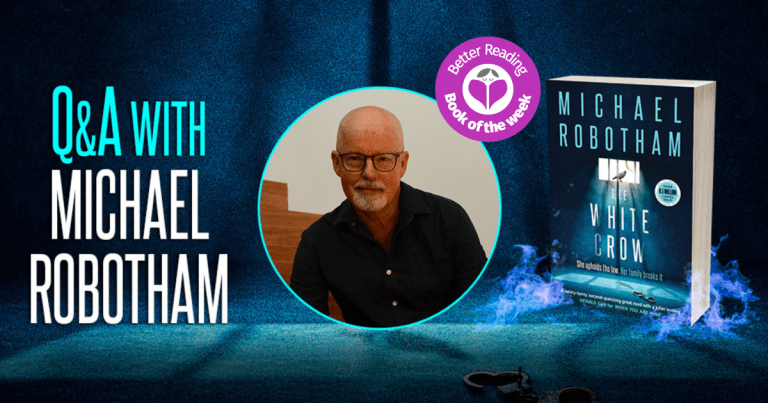
Briefly tell us about your book.
Several books ago, I wrote what I thought was a standalone called When You Are Mine, which featured a young ambitious police officer, Philomena McCarthy, who had defied the odds to join the force because her father and uncles were notorious London gangsters.
I loved the tension this story created, as Philomena tried to keep her two worlds apart. I also fell in love with the McCarthy brothers, who were funny, charming psychopaths, prone to violence but devoted to their family and friends.
I knew almost immediately that I had to bring them all back again, which I’ve done in The White Crow.
The story begins when two major events collide. On patrol one night, Phil stumbles upon a barefoot child in pyjamas wandering the streets of North London. She takes Daisy home and the child home and discovers the aftermath of a brutal home invasion.
Meanwhile, only a few miles away, a prominent London jeweller is sitting in his ransacked store with a bomb strapped to his chest. Millions are missing.
These two events are linked and increasingly the evidence points to Edward McCarthy and his brothers as being responsible.
Ultimately, caught in a vicious gang war, Phil will have to make a choice on who to believe and who she can trust – the badge or her own blood.
If I looked at your internet history, what would it reveal about you?
It would reveal that I am a serial procrastinator and a chaser of rabbits down holes. I will type a search to discover whether pathologists can tell if a human hair came from a living person or a dead one and finish up reading about Genghis Khan’s favourite yak recipe and what makes mown grass smell so nice.
Does the creative process get easier for you with each book?
You think it would get easier after nineteen books, but I go through the same angst and heartache with every novel. I don’t plot in advance and begin with a ‘what if’ moment. In the case of The White Crow – what if a young police officer came from a family of criminals? Then I create the characters and let them lead the way.
I often liken it to climbing a mountain, where you can only see the rockface immediately in front of you. I never know how much further I have to climb or if I’m going to hit a dead-end and I have to climb down and start again. But when you I do reach the top – the view is bloody amazing.
How did you think of the title of the book?
It took me a long while to come up with a title for the book, but ultimately it turned up in the text. When we think of an outsider in a family, we often refer to the black sheep, but in many parts of Europe, they use ‘the white crow’.
This a perfect description for Philomena, who is the white crow in her family. The outsider. It also resonates because, in the wild, white crows are more prone to fall prey to predators because they stand out more than other birds.
What’s the easiest and most difficult parts of your job as a writer?
The easiest part of being a writer is being able to do this full-time, which is a privilege enjoyed by very few Australian authors and creatives. This has allowed me to write nineteen novels in the past twenty-one years as well as touring and promoting my books around the world.
The hardest part of being a writer is my own desire to make every book better than the last. I wrestle with every novel, convinced this one will expose me as a fraud or that I’ve run out of ideas. I have signed every book to my long-time agent with the same message, ‘Dear Mark, we’ve fooled them again.’



Leave a Reply