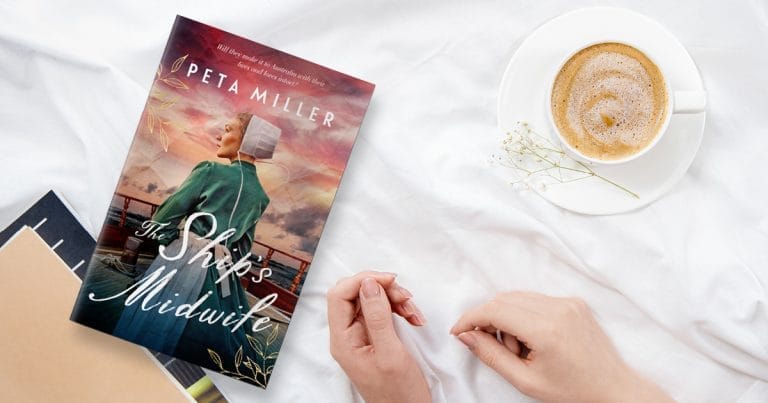
Briefly tell us about your book.
It was a voyage the survivors would never forget …
Seventeen-year-old Sarah Hallow is on her own after the death of her mother. 1850’s England is a time of poverty and famine so, with few prospects, Sarah boards a ship bound for the new settlement of Brisbane, Australia. Alongside, her fellow passengers, she is tested to the limits by the journey when disease plagues the ship. On arrival in Moreton Bay, they are all pushed to the edge as their situation worsens.
The Ship’s Midwife is a historical drama, an adventure story, a journey into the unknown, one where disaster and tragedy challenge all those involved. It is also a story about love and finding one’s place.
What inspired the idea behind this book?
I spent time on Stradbroke Island where the inspiration for the story began after a walk in the local cemetery, where a memorial to the passengers of The Emigrant stands. I was struck by how many people perished after the ship reached Moreton Bay, just when they thought their ordeal was over. I couldn’t shake thoughts of how they must have felt, how desperate they must have been and what these conditions might do to people. I wanted to explore how it might feel to leave all you know behind and head into the unknown, the unfamiliar and uncomfortable. Whether it’s by choice, or not, it takes immense bravery to find a new place. And when things go terribly wrong, it takes more than courage to keep going.
What was the research process like for this book?
I researched for months, using many sources including journals and diaries from ship passengers during that time (eg: Robert Whyte’s 1847 Famine Ship Diary and Tom Petrie’s Reminiscences of Early Queensland) as well as online and library resources. I amassed a good collection of books on various Australian history topics and conferred with two midwives, one of whom read the m/s for accuracy. Subjects ranged from historic Brisbane, sea voyages, clothing, food and housing, 19C diseases and conditions, speech – I particularly enjoyed researching songs, sayings and swear words. I visited Stradbroke several times, where the old quarantine station has been turned into a museum.
Tell us about your background and what led you to writing this book.
I have worked in the Book Trade since 1986, starting in retail at Dymocks in George St, Sydney. I’ve worked for publishers, school suppliers, children’s book specialists as well as a number of retail outlets, currently at Berkelouw Books, Eumundi. I’ve been honing my writing skills for a number of years, with some success with short stories, but also a drawer full of projects and my ‘starter’ manuscript, an unpublished story for middle grade readers. The Ship’s Midwife evolved over a number of years, starting off as YA fiction and being re-written as adult fiction after a mentorship with a Harper Collins author.
What’s your daily writing routine like and what are you working on at the moment?
I wish I had a daily routine! I work in a busy bookshop most of the week so tend to do admin and social media on those days, leaving my days off for writing. I like to spend the whole day immersed, occasionally coming up for air to play with the dogs or to do some vaguely useful household chore. I often have a soundtrack, not one I listen to as I write, but songs that put me in ‘the zone’ before I begin.
I’m working on the first draft of another historical manuscript, this one with two timelines, so double the research and storylines. I learnt a lot from writing The Ship’s Midwife and hope to put these lessons into practice with this manuscript ie: better plot planning. It may not take as long to write!


Leave a Reply