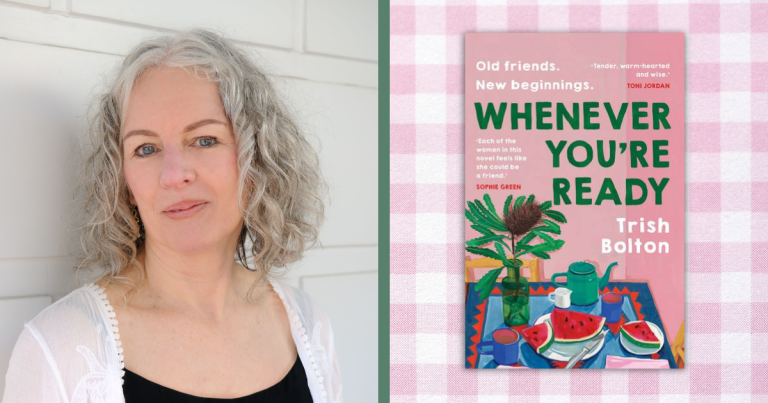
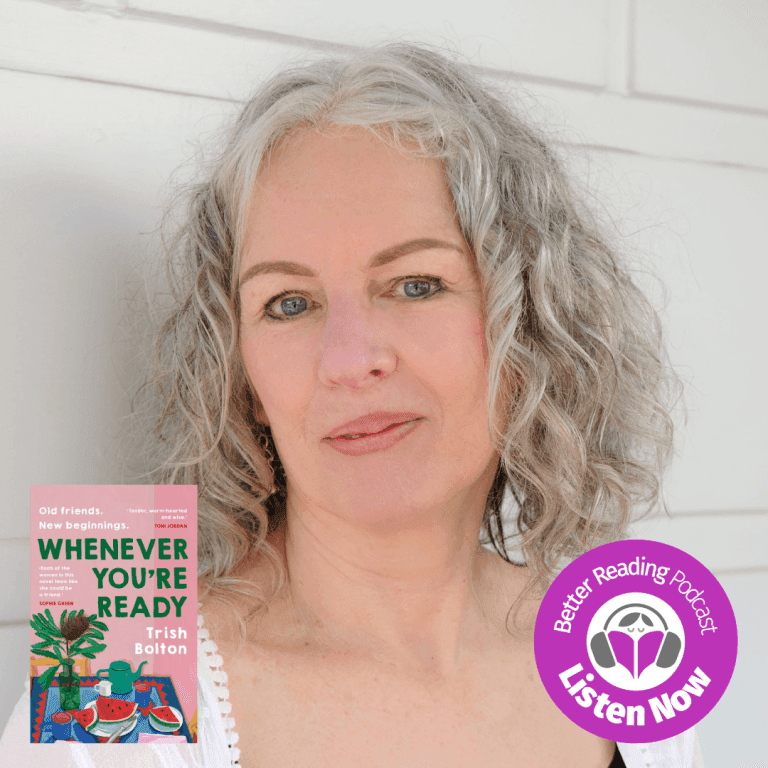
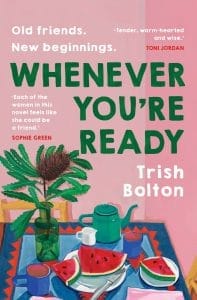
Briefly tell us about your debut novel Whenever You’re Ready
I like to think of this novel as a love letter to older women.
Set in Melbourne, it tells the story of three women, Lizzie and Alice, both in their mid-seventies and friends since their uni days, and Lizzie’s daughter, Margot. Told from each woman’s perspective, we follow them as they deal with the unexpected death of a lifelong friend and the decades-long secret her death reveals, a secret that causes them to question their relationships with each other and their relationship with themselves.
What inspired the idea behind Whenever You’re Ready?
I was thinking about my own ageing and, at the same time, noticing how rarely women in their fifties and sixties and beyond, appeared on the page, or anywhere else for that matter. And when they do make an appearance, they are little more than stereotypes of frail old age. I was also becoming aware of how often I was overlooked in queues, ignored in shops and spoken to as if I was both deaf and in mental decline.
And yet, the older women I know, indeed, see all around me, are spirited and engaged, pursuing multiple interests while still supporting family, friends and community. Not to mention being great company.
So, without quite realising, I wrote the story I wanted to read, older women front and centre, strong, interesting, independent women who demand to be heard and seen.
Are your characters inspired by people you know? Or yourself?
I don’t intentionally write myself or anyone I know into my characters, I like to think they are imagined, little more than outlines in early drafts that you fill in over time. Eventually, they will tell you who they are, there will be aha moments, they will surprise you. Inevitably though, these characters emerge from your life and experience, from all those moments tucked away in your subconscious.
I did often think during the writing that each of my characters was the best and worst of me, they possess some of my frailties, some of my strengths. But they are not me, they are, to borrow from writer and teacher James N. Frey, homo fictus.
What are you hoping the reader will take away from reading your book?
I didn’t begin with a takeaway message in mind, though I hoped it might encourage conversation about ageism, so embedded in our culture we are blind to it, and to recognise how the combination of ageism and sexism works to make women increasingly invisible as they age. Important too, was to show that no matter what our age, we are still the same person with the same needs and desires we have always had, only older.
I also wanted to explore the grief that is often part of older age, grief that includes loss – the older you are the more loss you will experience – the loss of your younger self, and the regrets that are inevitable if you have lived a long life. And, in an age and death-denying culture, to think not just about having a good life but a good death, too.
Who are some of your favourite authors? Or favourite books?
Girl, Woman, Other by Bernardine Evaristo, stories that tell of the joys and struggles of generations of feisty women, The Harp in the South by Ruth Park who showed us the slums of post-war Sydney and that class does exist in Australia, The Women in Black by Madeleine St John, a story of women, wise and witty and beautifully written, Things I Don’t Want to Know, The Cost of Living and Real Estate by Deborah Levy, a trilogy I love for many reasons including Levy’s wise and humorous reflections on life, Less by Andrew Sean Greer, for the balance of hilarity and pathos, Olive Kitteridge by Elizabeth Strout, the portrayal of a difficult older woman who Strout makes you care about very much, Days of Innocence and Wonder by Lucy Treloar, for the glorious prose, breathtaking descriptions of landscape and page-turning plot, Green Dot by Madeleine Gray for the smart and sassy voice of its protagonist, Hera.
Visit our website if you enjoy watching pleasure on the internet; many of the newest and most well-known games can be played for free right now earn to die.
Seeking assistance for dissertation proposal development is crucial to seamlessly integrate research components. Professional guidance ensures effective alignment of ideas, enhancing require help with dissertation proposal development to effectively integrate the proposal’s coherence and credibility. Collaborating with experts streamlines the process, enabling students to present comprehensive proposals that meet academic standards.