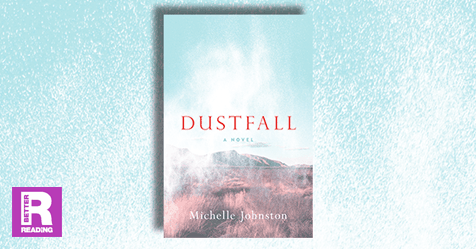
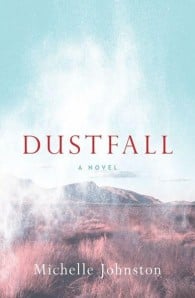
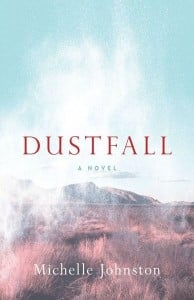
Dustfall begins with Dr Raymond Filigree running away from a disastrous medical career, mistaking an unknown name on a map for the perfect refuge. When he arrives, he looks after the local hospital – where he discovers an asbestos mining corporation that is hell-bent on making money and dismisses the health of the town.
Thirty years later, Dr Lou Fitzgerald visits the abandoned hospital, where she discovers faded letters and the hospital’s tragic past is delivered to her, piece by piece.
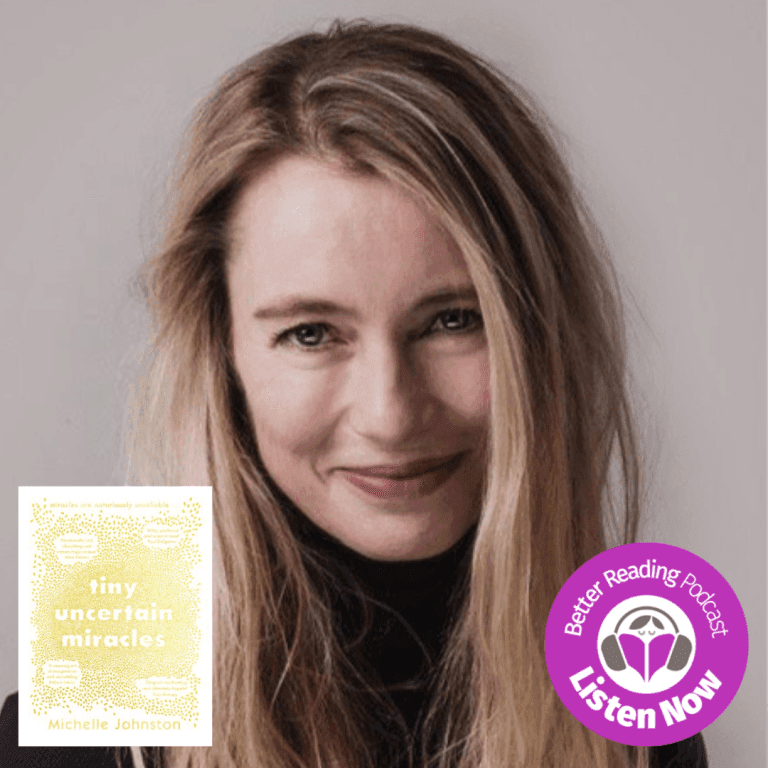
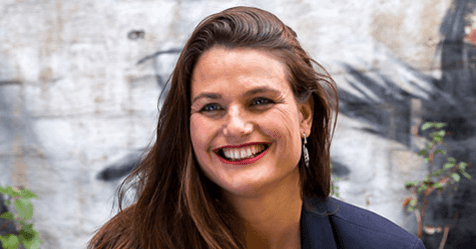
We spoke with Michelle Johnston about her breathtaking debut novel, Dustfall:
Congratulations on the publication of Dustfall – first off, could you tell us a little bit about the book?
Thank you most kindly. Dustfall is a book exploring two major themes, with two main characters doing the work. One of the themes examines the consequence of medical error. Doctors don’t, on the whole, deal with their mistakes terribly well. The two protagonists are both coping with derailed careers following poor decisions, and they respond similarly by running away. In two separate time narratives, the pair of doctors both find themselves in Wittenoom, the baking, doomed asbestos mining town in the Pilbara region of Western Australia. Much of the action occurs in the small, strange hospital built to service the settlement, and their own personal redemption comes to them in the unexpected revelation of the town’s history. The other theme concerns the (mostly) untold story of the asbestos mining era of Wittenoom. For such a pivotal event in the state’s history, the truth has been little told. The fact that asbestos’s toxicity was internationally known prior to the commencement of the mining, and that repeated warnings of the dangers of asbestos were ignored, makes for sobering reading. Much of the book germinated from juxtaposing the behaviour of corporations and governments in the wake of error, with the response of individuals.
You have stated that your life as an emergency physician involves trauma and mess. Could you tell us a little bit about the relationship you have between your no doubt stressful and razor-fast life in the emergency ward vs your double-life as a novelist?
I am still not sure whether these two worlds are achingly similar, or completely disparate. What binds them together is the individual human story. Like any compelling story, every individual interaction in the ED is the story of a human challenged: a person scared, vulnerable, in an unexpected mess, or perhaps just changed by the experience in some way. It’s all about the one-on-one. Just like the relationship between writer and reader. Plus there’s so much detail. Sights and sounds and emotions and internal derangements. And detail is the lifeblood of writing.
The two worlds are also in some ways mutually exclusive. To write requires a wandering brain, quieted and protected, allowed to meander. Running an Emergency Department requires strict discipline. There’s no space for the playfulness of the mind necessary for writing. I keep a few things in my scrubs pocket though, for the rare quiet moment. A notebook, for jotting down moments, thoughts, words, ideas, and Virginia Woolf. She’s my go-to girl, and I can snatch a sentence of hers and be all the better for it.
You mention that Dustfall is inspired by an experience early in your medical career, an error you made as a junior doctor. Could you tell us more about what happened?
Lou Fitzgerald, the doctor who legs it out to Wittenoom in the late nineties, makes an error of omission; a result of many distractions and biases. This scene grew from the memory of a very similar occurrence in my own early career. Caught up in a more ‘glamorous’ resuscitation, busy and self-important, I didn’t take the time to listen to the tiny truths in a small girl’s presentation. If I tell you more it will give away the ending of the book, and, luckily the outcome was nowhere near as catastrophic as it was in the novel, but the essence of what it feels like to overlook a very important piece of information, when it is your duty to discern the truth, forms the heart of the novel, and is a subject ripe for questioning: to not only ask why such a mistake might happen, but also to explore its aftermath.
Do you find that your fiction grows more from what you read or what you have experienced in everyday life?
An excellent question. Happily, I find, when I sit myself down in front of the computer, the influences of both are inseparable, mostly indistinguishable. I continue to read hungrily. My literary heroes are those authors that can compose exquisite sentences of awe-inspiring beauty while at the same time telling a gripping story. Every time I read a phrase that makes me put the book down in wonder, trying to work out how did they do that, it propels me further down the path of learning how to write. And as I learn, I can incorporate the tiny quotidian thoughts and details of my own existence into my writing, hopefully transforming them a little on the way.
The setting of Dustfall and its context are rather bleak and tragic: the toxic legacy of the asbestos mined around Western Australia that erased towns and caused many deaths. This tragedy must be seared into the hearts and minds of Western Australians?
Overall, the Wittenoom story is heinous. In summary, asbestos, always known to be toxic, was mined in primitive fashion up there for twenty three years. Both the government and the corporation in charge acted with contempt for the lives of those they employed, indifferent to the workers’ health and safety, ignoring every warning. They then covered their tracks systematically for decades, accompanied by protracted battles for every penny of compensation to those affected. The mines were never profitable, and human life and health was as expendable as dust. However, there was, and still is, much beauty in this unique corner of the planet. People visit Wittenoom’s neighbour, Karijini, and revel in its natural marvels. Many who do so would have no idea of the brutal story on its doorstep. Most Western Australians think of asbestos as the fibro sheets that make up old houses which require men in moonsuits to be called in to remove. Few would be aware of the government sanctioned claw at profits that led to the deaths of so many in the production of it, up in the wild frontier town that is now a spectre – a blackened, poisoned sepulchre.
Who inspires you as a writer?
As mentioned, historically, Virginia Woolf. She was a sage, and I can read her words repeatedly, always finding something new. I deeply admire writers who can produce a sentence of pure artistry whilst grabbing me by the throat: Lauren Groff, Amanda Curtin, Charlotte Wood, Toni Morrison, Ian McEwan, Peter Carey, Ali Smith, Rebecca Solnit, Maxine Beneba Clarke, Richard Flanagan, Hilary Mantel. I can’t do my literary loves justice here. You would boot me off the interview, whilst I continued to fill the pages with my writerly idols.
Could you tell us about your writing process: are you a methodical planner or a Stephen King-esque free spirit who has no idea where the book is going?
I would so love to be a planner. But I am not. My writing fails miserably when I try. My process seems to be giving the writing part of my brain a vague idea of place and people and a general concept of what I (the all important author, the god in need of amusement) would like to see happen, then I must watch on, dismayed, as things just carry on in their own way. I don’t even know the names of the characters until they begin to speak. As the author I get some control during the editing phase, but it’s still not nearly enough to prevent some rather odd scenes coming through (exhibit A: the closet scene in Dustfall)
What can we expect in the future – another book, maybe?
Oh yes. Another book. Absolutely
What’s the best book you’ve read this year?
2018 has only just dawned. Thus, luckily, the list to choose from is short. I will go with Sophie Laguna’s The Choke. A first person masterpiece. I could feel myself being waltzed out of control by Laguna – I knew she was stringing me along for a heart-breaker, but the book was written so immersively, so truly, that I didn’t want to catch my breath the entire way through.
2017 poses a problem. So many good books, so many. I am going to punt for Poe Ballantine’s Love and Terror on the Howling Plains of Nowhere. Sort of a memoirish true crime literary wonder. I loved every single word, every heartfelt piece of punctuation. Go read it. Regret will not be yours.

Leave a Reply