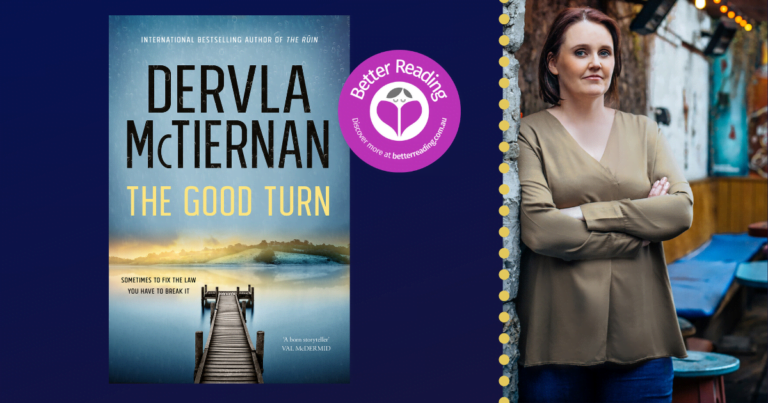
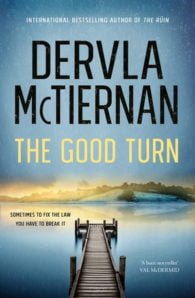
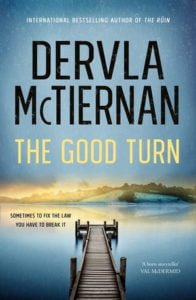
Police corruption, an investigation that ends in tragedy and the mystery of a little girl’s silence – three unconnected events that will prove to be linked by one small town. Can you tell us a bit more about The Good Turn?
At the opening and at the heart of the book is very young woman, Anna Collins. She’s a single mother and her little girl, Tilly, has stopped speaking. She hasn’t spoken a word in three months. Social workers think that Tilly may have experienced some kind of trauma and when it looks like they may try to take Tilly away, Anna decides to run. She gets on a bus and she disappears into the west of Ireland, to a small fishing village on the far west coast.
Meanwhile, back in Galway, another young girl has been abducted. Detective Cormac Reilly and Peter Fisher are desperate to track her down before it’s too late, but, strangely, they are getting absolutely no support from their boss.. Working under enormous pressure, Peter Fisher makes a fatal mistake. In the aftermath he’s faced with a choice – lose his job or accept banishment to a small fishing village on the far west coast …
So we have Peter and Anna in this little village…and back in Galway Cormac Reilly is trying to finally get to the truth of the power struggle within the gardai, to save Peter and himself, and maybe even the greater good.
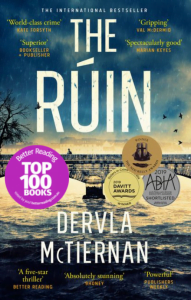
The Ruin was a huge hit and The Scholar equally well received. No second book struggles there. How was the process different for book three?
I think every book is different. With The Ruin I had absolutely no idea what I was doing, and it showed. I threw away every word of the first forty thousand I wrote with the exception of the prologue. And when I re-wrote those forty thousand words I ended up binning most of that draft too. I was essentially learning how to write on that novel and I wrote myself around in circles, down blind alleys and into unnecessary sub-plots, all of which I had to cut and fix before I could find my way to the final novel. I was pretty sure when I finished The Ruin that there had to be a better way!
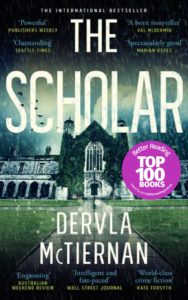
When I wrote The Scholar I found a process that worked for me. It was a pretty elaborate method that I had adopted (with a few adjustments) from a brilliant book on writing by Elizabeth George, called Write Away. That method, which involves doing a lot of character work upfront followed by pretty detailed outlines, worked really well for me for The Scholar and I was sure that I had found my method. The one I would use for every book.
As you would say in Australia – Yeah, nah.
When it came to writing The Good Turn I found that that method wasn’t working for me the same way. I did all of the up-front character work and some outlining, but I felt that I needed to let the writing flow a bit more. To feel my way into the book a bit more organically, and then go back and work on structure. So The Good Turn was a mish mash of the completely organic approach to The Ruin, and the more structured approach I took for The Scholar. And I’m still working that way now. These days I do whatever is working for the book. That might be a lot of detailed outlining, or it might be handwriting six pages to find my way deeper into a character. What has changed for sure is that I feel I have a better instinct for when things are going wrong, when the story is losing that feeling of being alive. I recognise that earlier now, so I will stop and go back and figure out where I lost the thread. A few years ago I might have continued on and written ten thousand words of dead wood before realising I had gone wrong, so this is progress!
What do you hope the reader will take away from this book?
First and foremost I’m always aiming to entertain. I’ve been a reader for many more years than I’ve been a writer. What I wanted in a book, what I still want in the book, is a world I can disappear into and characters who make me feel something. So that’s what I want, more than anything. I want my readers to care about the characters in my books, for them to feel completely real. There are themes in this book about family relationships and the degree to which we should feel obligated to those relationships. About police corruption and personal corruption and the grey areas of life. I think these are issues worth thinking and talking about, so if my books starts a conversation for some people that would also make me very happy.
What is something that has really influenced you as a writer?
I’m influenced by creative people. People who are committed to creating the very best work they can, whatever form it takes. I’m inspired by writers who dig deep and write with absolute honesty. I just finished Marion Keyes’s new book, Grown Ups, and it blew me away. I’ve been very inspired by young female musicians who seem to just have preternatural levels of talent and self-awareness and who are so utterly committed to their art – I’m thinking about women like Lady Gaga and Pink and Taylor Swift. They just seem to be utterly uncompromising creatively, and at the same time they are CEOs of their own careers. They are so very brave and if it’s late in the evening and I’m struggling with something I listen to some music in the background or watch a music video on YouTube and they kick my ass so I get back into it and work harder.
What’s your daily writing routine like and what are you working on at the moment?
I’m writing every day at the moment because I’m working on a novel and I’m just a few weeks off finishing the first draft. Monday to Friday I can work when the kids are at school, so I try to get as much done as possible between 9 am and 2pm. I work again most nights when the kids are in bed, and I work four hours or so on Saturday and Sunday. That’s a bad habit that I’m trying to get out of, but it’s necessary for right now. I love the writing, and I would work all day if I got the chance, but it isn’t good for family life if my head is always in the story!
Leave a Reply