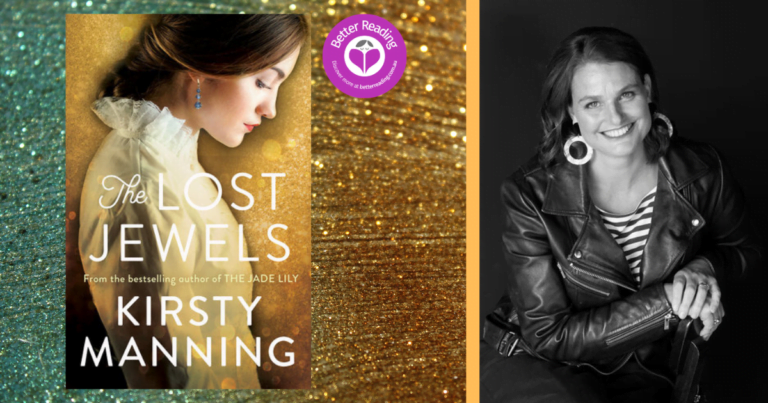
A conversation with Kirsty Manning, author of The Lost Jewels
The Lost Jewels follows a century-spanning treasure hunt. What’s the true story that inspired it?
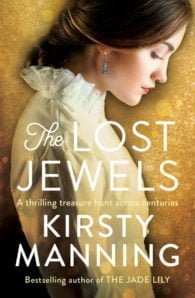
The Lost Jewels is a work of fiction inspired by the true story of the Cheapside Hoard, dug up in a Cheapside cellar in 1912 and forming a significant collection at the Museum of London, and also at the British Museum and the Victoria and Albert Museum.
While the Cheapside Hoard is one of the most famous cache of jewels in the world, it is also the most mysterious.
How could someone neglect to retrieve 500 precious pieces of jewellery and gemstones? Why did nobody claim it in the subsequent years? Who were the workmen who actually discovered the jewels in 1912?
The Lost Jewels is my imagined tale woven between the facts. For me, a novel begins between the gaps of history. I build my world on the bits we don’t know. This gives me opportunity to explore the dark, difficult and joyful parts of human nature.
In the 1600’s, Cheapside was the hub for gold, silver and precious gems that had threaded their way around the world to London. However, this century was also filled with fire, plague, revolution and an expanding empire … Seventeenth-century London was a city equal parts thriving and in turmoil. There were a million reasons why someone might not return for their precious jewels.
London was in turmoil again in 1912—on the brink of war—with women marching in the street demanding the vote. Both these eras seemed ripe for fictionalising, placing strong, interesting women at the forefront of each story.
The action in The Lost Jewels takes place in London instead of Australia. What made you want to branch out?
It wasn’t a deliberate choice to not have any of this book set in Australia, more a reality that the jewels I was inspired by for this book were found—and now stored—in London. So, I decided to follow the trail of those jewels back to the origin.
But I do have a sexy photographer who loves to surf—who is Australian, naturally!
All your books so far have had parallel narratives – what fascinates you about this style of writing?
I think so often we are very focused on creating a bright, shiny future. I’m certainly wired that way … and some days it is completely overwhelming. I’m trying to take stock a little more and slow down. Allow myself to daydream more (if that’s possible?)
I love weaving between history and facts, places and time. Showing how our history shapes both our present and future. Trauma and hope can carry through in equal parts, valuable lessons can be learned if we lean into history enough.
I think there are tiny pieces of me in all my characters, and certainly Kate’s preoccupation with jewellery and history in The Lost Jewels channels that constant pull I feel between the past and present. There’s a scene that illustrates this when Kate recalls a moment just before her partner, Jonathan leaves her:
‘Katie,’ he’d said with his typical surgeon’s plainspeak, ‘you spend all this time travelling around the world chasing other people’s stories. When you’re home, you’re hiding in that library wallowing in the past, looking at other people’s treasures. When’re you going to look up?’
But Jonathan could never understand what a joy it was to spend hours deep in books and archives, studying precious jewels that whispered secrets from long ago.
Like all your novels, The Lost Jewels features two strong women at the forefront. What do you love about writing strong female characters?
What don’t I love? I mean, nobody queries a strong male character …
My readers are smart, savvy women and I hope they see themselves reflected in my work. I also love bringing to life forgotten pockets of history—in particular, women’s voices that have long been overlooked or dismissed.
In this book I really wanted to honour the work of historians, librarians and curators. We often see the end product – the exhibition – but we don’t see the hours of painstaking research that goes into jig-sawing together our history.
My 1912 historical character Essie, is stymied in London by poverty and class. The suffragette movement was happening in London, but she was just too busy trying to pull her family through life and give those she loved more opportunities than she had. It’s a seemingly simple, humble goal … but women around the world are doing this every day–have been doing it throughout history–and they are unsung heroes.
Aside from writing you also co-own two wine bars in Melbourne and Sydney. What’s your favourite drop?
Champagne, always! My favourite is by a small grower-producer called Pierre Peters, particularly the cuvee rose. I also can’t go past a great Chardonnay. Australian brands I love are Giaconda, Hoddles Creek and Tolpuddle, but for something super-fancy I might look to something from Mersault.
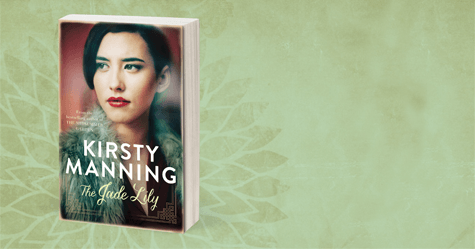
The Lost Jewels by Kirsty Manning is published by Allen and Unwin and available from 31 March, 2020.
Leave a Reply