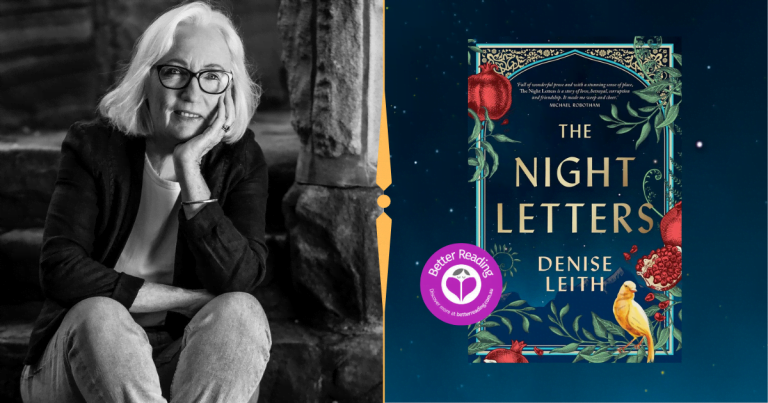
Briefly tell us about your book.
The Night Letters is a story of love and friendship in all their strange guises. It is also a salute to the strength and tenacity of the women of Afghanistan.
When a young Australian doctor leaves Sydney to work in a small square in Kabul she is confronted by a culture and value system that challenges her on nearly every level but she knows that to continue living in Afghanistan she must hold her own counsel.
At first, Sofia is seen as a curiosity, but over time she is welcomed into the square until she becomes their ‘dear sister’ and Shaahir Square has become her home. Five years after first arriving she realises that the life she once lived back in Sydney is now as foreign to her as Kabul once was.
The Night Letters explores the friendships within the square from the local shop keepers like Babur, who’s chaikhana was once a famous tea house on the Silk Road to Sofia’s grumpy landlady, Behnaz, who carries in her heat a terrible secret. Iman, And while Sofia’s receptionist, Iman, is a young woman impatient to tear things down she lives in a world where change is not always welcome.
When Omar, the local apothecary, steals the first night letter from Behnaz’s gate his well-meaning intentions to protect his friends only succeed in sowing fear and suspicion. With young boys going missing from a nearby slum and Sofia’s former lover returning her world is about to change again.
Does the creative process get easier for you with each book?
No, actually this book was the hardest to write. My first book, The Politics of Power, grew out of my PhD and was a fascinating process. My second book, Bearing Witness was a gift to research and write. What Remains, my first novel, had its genesis in Bearing Witness and ‘flew’ out of me in three weeks, although it then took me a couple of years of rewriting to learn how to write fiction – such an alien process to non-fiction.
The Night Letters, my second novel, was six years in the making and was the most difficult book to write, mainly because I was trying to fit two novels into one. It was only when I threw away at least 1/3 of the book that the writing became easy and the characters and the story came to life.
How does it feel to hold your book in your hands?
This is an interesting question considering holding this book felt completely different to my other books.
I had complete (maybe naïve) faith those first books would be published so holding them in my hands was exciting, but there was always a sense of, ‘Well, of course, I’m holding this book in my hands. This was always going to happen’.
Because The Night Letters is a story set in Afghanistan with a paedophilia subplot I was never as confident it would be published. But as a journalist/author friend of mine says, ‘You can’t write a book until you can’t not write it’ and I couldn’t not write The Night Letters. When I finally held it in my hands there was the usual thrill but also a different sense of pride after the difficulty of its birth.
What is something that has influenced you as a writer?
Truth and challenging established or common belief systems and stereotypes. My background is academia. My area of specialty was war, human rights, foreign policy and the developing world. Every book I have written so far, including The Night Letters, has in some way been related to that.
In The Night Letters, specifically, I wanted the reader to look beyond the stereotype and know Afghan women as strong, gutsy and determined. When you understand how hard they have had to fight and how much they have achieved, then you will understand much they have to lose if/when the Taliban return to power. I want them to be recognised for their achievements and I don’t want them to be forgotten or abandoned.
I have travelled extensively and have been to strange and exotic places and what I have learnt is that below the learned experience of culture and the environment, on a very basic level, we are all the same and want the same things: to be safe and happy. Afghans are no different.
In The Night Letters I also wanted to highlight the issue of bacha bazi (paedophilia) in Afghanistan. I would like more people to be outraged by this practice so that the Afghan government do more to address the problem.
What’s some great advice you’ve received that has helped you as a writer?
I once heard Richard Flanagan say that if we write about what we know then we are simply writing an autobiography. Our job as fiction writers is to imagine. That freed me, although, after years of writing non-fiction, I still have to fight an overwhelming urge to make sure everything is correct.
Where do I purchase this book
Denise- just in case you don’t see review on FB – I want to thank you for signing my book which Alice sent up to me on the northern rivers.
I couldn’t put it down and felt transported to Kabul and could nearly taste the exotic flavours.
Alice sent it to me during one of my not so great days fighting melanoma tumour and cancer.
I LOVED IT – thank you.🌺🌹🌷