Briefly tell us about your book.
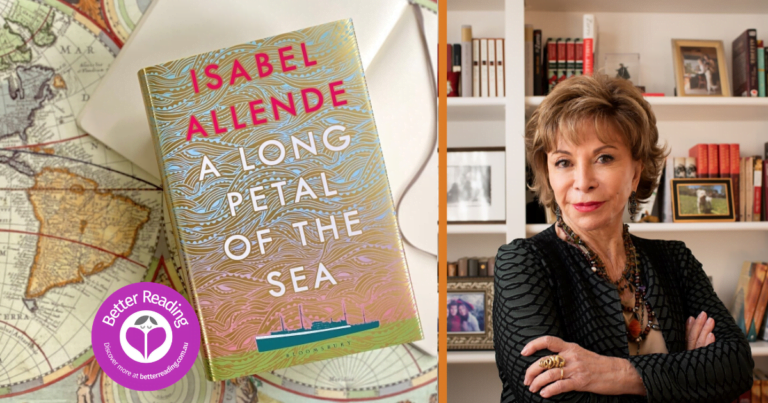
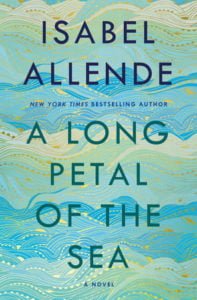
A Long Petal of the Sea is the story of some Spaniards who fled from the fascist army of Franco in January of 1939, at the end of the Civil War. Half a million people walked to the border of France seeking asylum. The Chilean poet, Pablo Neruda, convinced his government to accept some refugees, went to France, raised money to buy an old cargo ship, the Winnipeg, conditioned it to transport 2.200 passengers, selected them and send them to his country, where they were received with open arms. My protagonists, Victor and Roser, were among those refugees. They had a life in Chile for thirty years, until they were forced t go into exile again. It’s a story of love, war, displacement and resilience.
What inspired the idea behind this book?
In 1976, when I was living in exile in Venezuela, after the military coup of 1973 in Chile, I met Victor Pey. He had been one of the passengers of the Winnipeg and was living his second exile. He told me his story, which I carried with me for forty years, until I felt the urgent need to tell it, probably because the theme of displaced people is so relevant today. There are more than seventy million refugees in the world, mostly women and children.
What was the research process like for the book?
I have written historical fiction before and I have some experience doing research. In the case of A Long Petal of the Sea, the research was easy because it’s relatively recent history. There are still people alive whose parents – and sometimes themselves – lived through the Civil War in Spain. There’s a lot of information, books, documentaries, photography and personal testimonies. I also was in touch with my friend Victor Pey, who gave me the details that would have been almost impossible to find elsewhere. Unfortunately he died six days before I could send him the manuscript of the novel dedicated to him. He was 103 years old, totally lucid and still strong.
What are you hoping the reader will take away from reading your book?
I am a fiction writer, I don’t try to deliver a message to my readers, my intention is simply to tell a story that is important to me. My last three books, The Japanese Love, In the Midst of Winter and a Long Petal of the Sea deal in some way with refugees and migrants. This is something I understand very well, not only because I have lived it, but also because I have a foundation that is working with refugees in the southern border of the United States and other places.
Does the creative process get easier for you with each book?
The creative process is always scary. I start all my books on January 8th out of discipline and fear. If I didn’t have a starting day I would be procrastinating forever. Although I love the process of writing and often I have a story inside me, I know how difficult it is to get started, to find the narrative voice, the tone, the rhythm, not to mention develop the plot and the characters. But in the thirty something years that I have been writing I have acquired some self confidence. If I sit in front of my computer long enough, I can do it. I have never left a book unfinished.





Leave a Reply