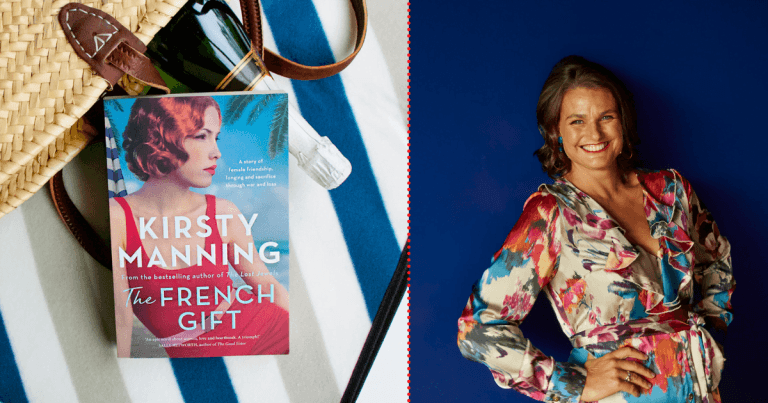
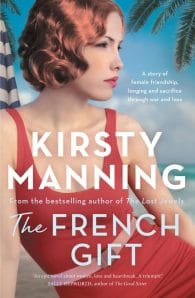
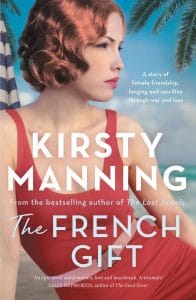
Briefly tell us about The French Gift.
The French Gift is a dual time-line story of female friendship, longing and sacrifice through war and loss, bringing together the present and the past.
The story begins with Margot Bisset – a French maid on the Riviera – who is convicted of murder after a glamorous party takes a surprising turn. She is interned in a German rayon factory, and develops an unlikely friendship with the brilliant writer and resistance fighter Joséphine Murant. In a German WWII rayon factory, two female prisoners support one another – and others – in horrific circumstances and form an unbreakable bond.
In her later years, Joséphine Murant retires to the Riviera and continues the career she has built as an international bestselling mystery writer.
Overlaying this is a contemporary storyline: the healing, hunt-for-truth story of Evie – and her 17-year-old-son Hugo – as they try to make peace and heal following the tragic death of beloved father/husband, Rafael, two years ago.
Mother and son decide to summer at an old family house in the Riviera—inherited from Rafael’s great-aunt Joséphine Murant – to help local museum director—the handsome and gentle Clément Dumas—prepare a retrospective exhibition.
Together they hunt for a missing manuscript that may uncover their shocking secrets and depth of friendship between the two women.
Your books are inspired by true snippets of history. What inspired the idea behind this book?
I love to explore different angles of well-known epochs. The French Gift is a work of fiction but like all my books, it is inspired by true snippets of history.
A paragraph in the excellent non-fiction book, The Riviera Set by Mary S. Lovell, lit my imagination. She described a decadent party arranged by a famous hostess, where one of the guests is (faux) murdered and the local police were roped in as part of the game.
What fun, I thought! What if I write a book about a decadent murder party … and then it goes wrong.
But I also wanted to write a story inspired by the ordeal of women in WW2 who were forced into labour in factories. We know so little about their history, and I stumbled across a translated version of a memoir by Agnès Humbert.
If you read her memoir – Résistance – (expertly translated into English by Barbara Mellor) you will see Agnès Humbert was: part of the Resistance, member of the subterfuge group Cercle Alain-Fournier, co-founded the clandestine newspaper Résistance, was tried, sentenced and imprisoned for espionage for five years at Cherche-Midi, de la Santé, Fresnes and Anrath prisons and endured forced labour at the Phrix Rayon Factory.
She allegedly recorded her thoughts in a book by Descartes: Discourse on Method and it has been suggested (though not confirmed) that she stored the names and material for 400 Resistance workers under her carpet in her Paris apartment. She was indeed arrested and interrogated by the Gestapo, and allegedly made friends with sympathetic guards and cellmates in both Cherche-Midi Prison and the Phrix Rayon Factory.
Unlike my heroine Josephine, Agnès Humbert was a key figure in the liberation, and stayed in Germany to assist the American troops hunt Nazis. Her story does not end at the Phrix Rayon Factory, for at 51 years of age she returned to a liberated France and to work and writing. She was also a devoted mother, daughter and wife.
Agnès Humbert was an extraordinary woman. It has long been my quest in historical fiction to draw attention to forgotten pockets of history. Agnes Humbert’s English translator – Barbara Mellor – have captured with accuracy and visceral reality a type of reportage a female first-person experience of the Résistance and shined a spotlight on the forced labour factories used in WW2 that have long been overlooked in history.
In my heroine, Josephine, I wanted to capture some of that resilience and inspiration of wartime women. To honour the women who were forced to work in atrocious conditions, and whose stories have largely been forgotten.
What are you hoping the reader will take away from reading The French Gift?
At the moment women are crying out for our voices to be heard. For too long, history has been written and recorded by men. War stories, are typically told from male perspectives. How many movies and books feature men as the lead: Gallipoli, Saving Private Ryan, Good Morning Vietnam etc, etc
But here’s the thing: women have always been strong. Women have always linked arms and dragged their loved ones into better conditions, to safety, to the future.
In my heroine, Josephine, I wanted to capture some of that resilience and inspiration of wartime women. To honour the women who were forced to work in atrocious conditions, and whose stories have largely been forgotten.
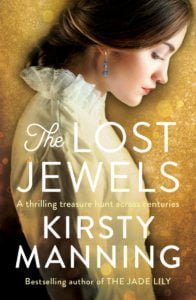
Like The Lost Jewels, The French Gift also explores motherhood. The art of letting go as your children reach the cusp of adulthood. It’s both a heartbreaking and uplifting time… it’s an exploration of how to let go, with grace.
What’s some great advice you’ve received that has helped you as a writer?
To let go of perfection and just write. You can’t edit a blank page. For me, the magic seems to happen in the rewriting.
Are you able to switch off at the end of a day of writing? If so, how?
Yes! I’m very good at it now.
I take my dog, Winter, for a walk and run through my ideas for that day and try to get clarity for the next day. If I’m at the beach I go for a long swim, or a surf (I’m not so good at the surfing. But I don’t care … it relaxes me.)
I listen to a lot of music, which calms me – or revs me up. Whatever I need that particular evening.
I’ll have a glass of vino as I cook dinner. Who am I kidding? While my husband cooks dinner. Also, I always make an effort to have a dinner with my family, wherever possible. It’s tricky as often we are ferrying to and from sport and other activities. I find sitting around the dinner table very nourishing, emotionally and physically.
I always end the day with a bit of Netflix, or a good book. I like to go off to sleep inspired by beautiful stories.
hello
i have life history to make it as book