About the Author:
Carmel Bird is a writer of both fiction and non-fiction. Her first collection of short  stories appeared in 1976. Since then she has published novels, essays, anthologies, children’s books and also manuals on how to write.
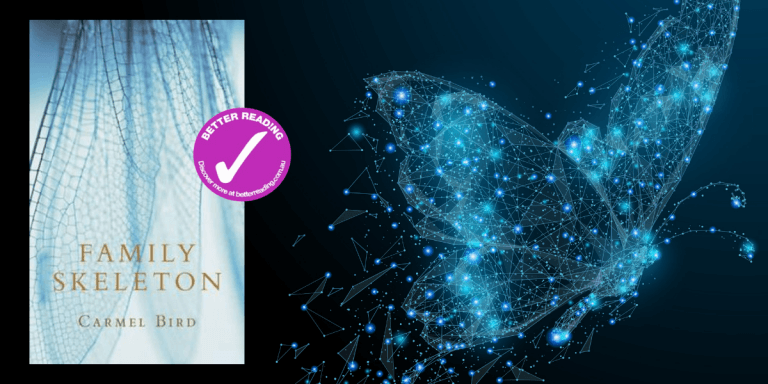
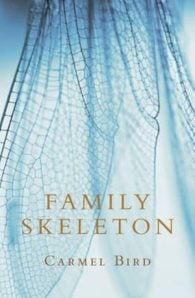
Purchase a copy of Family Skeleton here
Read our review of Family Skeleton here
Family Skeleton is your ninth novel. Can you tell us a bit about the story?
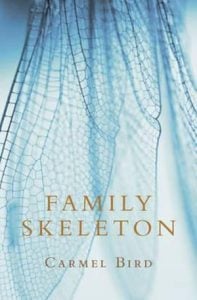
The time is the present. The place is the wealthy Melbourne suburb of Toorak. The O’Day family has a prosperous funeral business. They are powerful and highly respected. Margaret, the main character, is the matriarch of the family. Trouble arises when a distant American relative named Doria moves into town and starts poking around in the family archives. What scandals might she uncover? How can she be stopped? Margaret is determined to obstruct Doria’s progress, but at a terrible cost.
The story is told from two different perspectives – one is Margaret’s, and the other is that of a skeleton called George who lives in the wardrobe. George sounds more or less like a regular narrator of a novel, but from time to time the reader is reminded that he is not. Both characters have their limitations, but part of the fun is that they don’t realise this about themselves. The skeleton knows more than Margaret does. By giving the reader this dual perspective, the novel can be quite playful, even though the issues raised are serious and sometimes tragic. The skeleton sees right through Margaret, and that’s a great part of the fun.
There are lots of very memorable characters in Family Skeleton. Which character did you have the most fun creating?
Hard to say, but I think that Margaret’s late husband Edmund might have been the most fun. While Margaret is so moral and respectable, he is wicked. Margaret has always tolerated his extramarital affairs – for example he is probably the father of one of his own grandchildren. He keeps a mistress in the next street, and has two sons with her. Margaret generously treats this other family as part of the whole O’Day clan. Edmund runs the funeral business, and has established a cemetery that functions as a theme park called Heavenly Days, with crazy cafes and rides such as the Catacomb Café and the Spooky-Kooky. Edmund is all confidence, all male entitlement, and, I hope, quite funny but also tragic and hollow.
Family Skeleton is narrated by two characters. One is Margaret, the O’Day family matriarch, and the other is a male skeleton called George. What is it like to write the same story from two very different perspectives, and what do you think alternating perspectives bring to this novel in particular?
Well much of what Margaret says in instantly undermined by skeleton George who speaks directly to the reader, clarifying matters both past and present. Margaret delivers her story in the form of her journal which she imagines is quite frank about everything, but which still suffers from her respectable, rather hypocritical approach to life. In her, the reader is watching a powerful, confident woman gradually unravel, and although the novel is quite satirical and funny, Margaret’s end is shocking, and things that happen along the way are also terrible.
Your writing often incorporates elements of surrealism. How do you utilise these surrealist elements whilst still ensuring the story, as a whole, is believable?
As I write, the underlying images and truths of what is happening sometimes flip into view, and I let these shadows of reality move into the text. In Family Skeleton one of the more obvious of these elements is the presence of the skeleton himself. But perhaps the most dramatic moment of the surreal is when Margaret is so stressed, as she is driving the car to go to her ski chalet, that she hallucinates. This begins on page 212, ‘as she drove up the highway towards the snowfields…’ The narrative, in the words of the skeleton of course, veers between ordinary reality and weird unreality.
‘Margaret could see in the rear-vision mirror a convoy of six white cars, all with their headlights on. The sunlight and the rain caused the lights to appear to waver, to produce watery yellow beams that shifted and glowed in the mirror. The cars appeared to Margaret to be sinister and threatening, shark-like, milky, relentless, shadowing her, bearing down upon her. Then suddenly, with no apparent movement, they were no longer there. They had bled away into the landscape, disappeared down a side road to nowhere.’
In that paragraph, the word ‘milky’ is one that foreshadows a future event, and that will come back with destructive force.
You’ve written across a wide range of mediums – novels, non-fiction, short stories, essays and children’s books. Do you have a favourite medium to work in?
Writing a novel gives me the greatest satisfaction, largely because it offers so much freedom. Within a novel I can in fact include all the features of essay, short story, memoir and so on. It takes practice and skill to structure these elements within the novel form, but I find the result very pleasing. The early stages of writing a novel are so thrilling – the idea comes, and then I have the opportunity to explore the possibilities of constructing the narrative in such a way that the idea will live and sing its own melody. However, while I am in the process of writing a novel, I also write a few other things – it takes a long time to write a novel, and other short stories, essays etc do occur to me along the way, and do require their own spaces.
And finally, what are you working on at the moment?
I am just beginning the editing process of a novel Field of Poppies to be published in 2019. This is set in rural Victoria, in the fictional small town of Muckleton in the goldfields near Ballarat. The time is the present. A pleasant, wealthy, tree-changing couple, Marsali and William, in their sixties, buy a handsome historic house and are living there happily until things start to go wrong. The world outside isn’t paradise, but it turns out that the charming village isn’t paradise either. The title references the First World War, and there is a clear sense that the events of the twentieth century still haunt the twenty-first. The bones beneath the earth on the battlefields of France are a reality, as are the bones beneath the earth around Muckleton. Poppies grow in Flanders; poppies grow in Muckelton. Marsali and William will discover that in this troubled world you can run but you probably can’t hide.





Leave a Reply