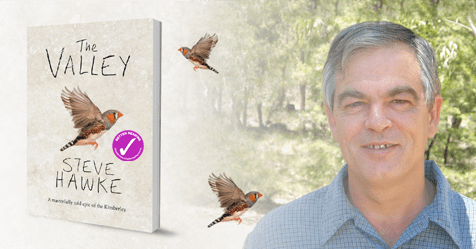
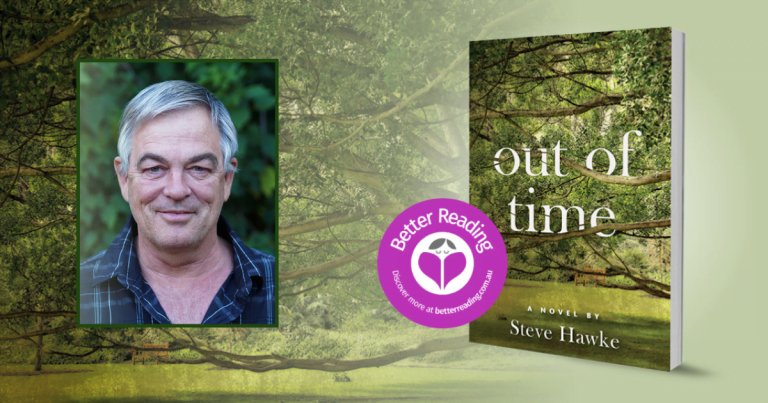
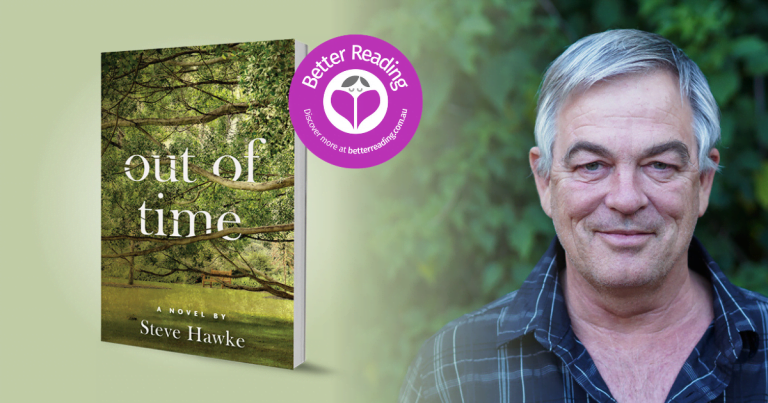
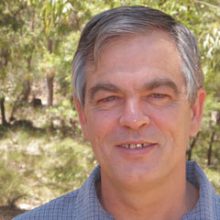
About the author:
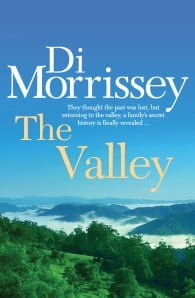
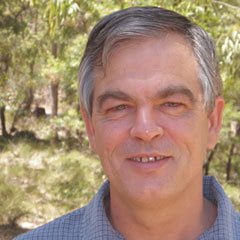 Steve Hawke grew up in Melbourne, but found his way to the Northern Territory and then to the Kimberley as a nineteen-year-old in 1978. Captivated by the country, the history and the people, he stayed for almost fifteen years working for Aboriginal communities and organisations. He now lives outside Perth, but continues his strong association with the Kimberley, returning most years. His writings on the Kimberley include Noonkanbah: Whose Land, Whose Law, the children’s novel Barefoot Kids, the play Jandamarra that premiered at the Perth International Arts Festival in 2008 and toured the Kimberley in 2011, and A Town Is Born: The Fitzroy Crossing Story. The Valley is his first adult novel.
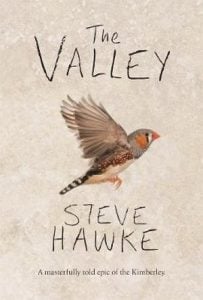
Purchase a copy of The Valley here
Read our review of The Valley here
The Valley spans four generations of one family. How do you keep track of all your characters and connections when writing a novel like that?
With great care at first. In fact, truth be told, the first attempt to write this story became too convoluted and complicated, and I had to make a fresh start.
Only a rare genius can make it roll out on the page seamlessly. You do your plotting work. You have the odd false start or blind alley that you have to back out of. You do lots of re-reading. But as you get the overall shape of the story clear in your mind, and work out the truth of each of your main characters, and which are the important threads of each one’s journey, the task becomes simpler.
And of course, once the main task is done, the sharp eye of a good editor helps to identify any remaining blips that need tweaking.
Family and human connection are strong themes that run throughout the book. Was there any particular reason for the story having this focus?
I’m not sure that I see it in quite this way, by which I mean I did not consciously set out to give it this, or any other particular ‘focus’. The story that I found myself telling is, in effect, a family saga. By definition, a family saga is going to deal with inter- and cross-generational connections.
Almost any good fiction – or at least anything that is of interest to me – deals with the connections between people, be they connections of blood, of love or happenstance; be they loving or hostile or indifferent. Often they are weird combinations of some or all of the above. The writer’s job is to make these connections interesting and relevant, and emotionally truthful. And in the case of a family saga like The Valley, these connections become a layered web that echo back and forth between the different generations.
What was the inspiration behind the book?
Is inspiration the right word? I call it a storyworm – you know, like the musical earworm – that got into my head and wouldn’t let go.
Dancer Jirroo, the main character in The Valley, was one of five Broome kids who formed the main cast of my children’s novel Barefoot Kids. I invented a backstory about his missing mother that was a fairly minor thread in that story. That backstory became the storyworm that I felt compelled to tease out and turn into a coherent novel. And to do that, I had to go back another couple of generations to the origins of her story. It unfolded in my head in reverse chronological order, you might say.
Beyond the compulsion to tell a story, my inspiration is that remote Kimberley world of Indigenous communities and cattle stations, and grand, harsh country that I have been lucky enough to come to know over the last 40 years. It is a world that very few Australians have access to, and I hope The Valley might give them that pleasure vicariously.
How is writing for adults different from writing for children?
Barefoot Kids is the only work I have written for children. I like to think of myself as eclectic, having done history, biography, a stage play, a libretto, and now, with The Valley, a novel for grown-ups. Given that Barefoot Kids was a multi-character, full-length, reasonably complex and nuanced book, the answer in my case is that they are not very different. Obviously there are areas of content and themes you can explore in an adult novel that are not appropriate in a children’s book, but the writer’s fundamental tasks are the same in both cases in my opinion: to create a world and characters that feel true and believable, that the reader can become absorbed in; and within the parameters of the world and the characters you have created, to tell a story that is not just interesting, but hopefully intriguing enough to carry the reader eagerly with you on the journey.
How has your time living in the Kimberley influenced your writing?
In the case of The Valley, totally. At one level the book is a big, long love letter to the Kimberley country, and the people who live there. The book and its characters do not move outside of the confines of the Kimberley. It exists in that world.
I lived in the Kimberley for almost 15 years after arriving there as a very young man, and although I have lived in Perth since the early 1990s, I have maintained a very strong connection, returning at least once a year, and often many times a year, through my ongoing work for Indigenous organisations.
One of the pleasures of writing the book, actually, was that mentally I could re-immerse myself in that world for hours at a time, whilst sitting at my desk in the Perth hills.
How important is physical setting to you? Does the landscape influence your writing?
For The Valley the physical setting is hugely important. It passes through Broome, you might say, but fairly lightly. Its real world is the high country of the central Kimberley plateau. Apart from the work I have done with people up in those parts, I have now done three substantial bushwalks in some of the really remote and isolated parts of this country. The first one was specifically research for this book. The subsequent ones have been done more out of love – you could even say infatuation – for this part of the world. The book is full of descriptive passages about this landscape, and I like to hope that I have done some justice to its grandeur, its beauty and its power in my evocation.
There is another, deeper layer too, of course. This land is lived in and loved by and cared for by the Indigenous peoples who have been a part of it for millennia, and are still its true owners. This relationship between the people and their country is something that lies at the heart of the book.
Are any of your characters based on real people?
No, in a word. The Valley is a work of fiction. Whenever I found a character in the novel assuming details or backstory that might bear resemblance to historical or contemporary individuals, I was pretty ruthless about rethinking and, if necessary, rewriting them.
Was it difficult making the transition between writing plays and writing fiction?
I’m eclectic in my writing, covering a pretty wide range of genres and topics, so there was no specific transition as such. The biggest difference is that writing fiction is a largely solo exercise beyond the feedback you seek as you go from family and readers and editors. Writing for the stage, however, is a far more collaborative and community-oriented exercise with input along the way from dramaturgs, artistic directors, designers, actors and so forth, with rewrites happening all the time, up to opening night and beyond. And of course a play is a creation that belongs to all of these other participants as well as the writer. It is not a matter of a transition, difficult or otherwise; they are just different beasts, and each format has a lot to recommend it.
Where are you based at the moment? Is there a strong writing culture there?
I live in the Perth Hills. I’m a bit of a lone ranger to tell you the truth. My partner Lesley is a writer, so you could say there is a strong culture within our four walls.
What’s your opinion on the writing scene in WA?
Clearly there are some really good writers in this state. Tim Winton and Kim Scott go without saying. But others like Joan London and Amanda Curtin and Craig Silvey are seriously good. I tend not to think of writers as specifically Western Australian or otherwise though.
What advice would you give budding writers?
Get a day job if you want to keep body and soul together. And I’m not speaking in jest. It is a field where supply exceeds demand, and as such is a far from easy road.
I don’t really have an answer to this question, I’m afraid. Everything that comes to mind sounds glib when I say it out loud.
Where do you write? Do you have a spot at home, a local cafe…?
I work from a home office that is a converted garage. Sliding doors at each end offer pleasing/distracting views of the trees and wildlife in this neck of the woods. Sometimes when I’m stuck, a spell in the hammock will bring inspiration.
Where is your favourite place to be when you’re in Perth?
The bush of Beelu National Park on the other side of the road.
What projects have you got coming up next?
I’ll soon be starting the editing phase on a second novel, Making Memories, that has been contracted by Fremantle Press. I’m working on a short book with the working title of Trailblazers, about the roles of Graham ‘Polly’ Farmer and Bill Dempsey as exactly that for Indigenous footballers. There is another book with a sporting theme that I am hopeful will eventuate. And there is what I hope will be a third novel quietly bubbling away. So, there’s plenty to keep me going.
Plus, it is looking very hopeful that in 2019 there might be two new productions of Jandamarra: Sing for the Country, a dramatic cantata that I wrote the libretto for and co-produced for an Indigenous company called Bunuba Cultural Enterprises.


Leave a Reply