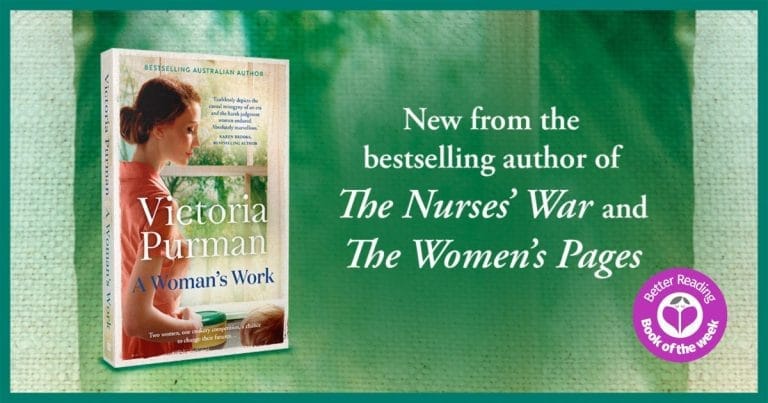
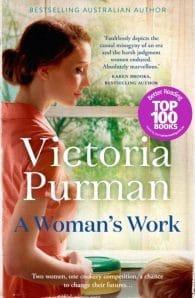
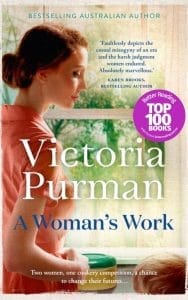
It’s 1956, and while Melbourne is in a frenzy gearing up for the Olympics, the women of Australia are cooking up a storm for their chance to win the equivalent of a year’s salary in the extraordinary Australian Women’s Weekly cookery contest.
For two women in particular, the prize could be life-changing. For war widow and single mum Ivy Quinn, a win would mean more time to spend with her twelve-year-old son, Raymond. For mother of five Kathleen O’Grady, the prize offers a different kind of life for herself and her children, and the chance to control her own future. But is it the competition prize that would give them a new way of seeing the world – a chance to free themselves from society’s expectations and change their own futures – or is it the creativity and confidence it brings?
I’m new to the rich worlds of Victoria Purman, but what a gorgeous entree A Woman’s Work is into them. A superb premise – and certainly one worthy of its own TV series – think Julia with a dash of Call the Midwife. A Woman’s Work is a tender meditation on women of a bygone era, with issues as current as those we struggle with today: keeping it together in the balancing act of life, how to juggle a family, work, relationships while retaining and honouring yourself.
Kathleen is the overwhelmed mother of five whose life is an endless stream of nappy changes and meal plans. She’s just trying to get through the day and keep it all going. She married young and her husband is a man of tradition, banning rice from his table in a showing of loyalty to his fallen soldier relative.
Ivy is a widowed single mum who got a taste for work during the war, and possesses an intellect beyond her position as a doctor’s receptionist. She struggles between her desires to provide her son with every opportunity possible, and the ongoing expectations of a conservative society. By entering the cookery competition, each woman gains a greater insight into their own potential.
Purman’s pace allows us the luxury of getting to know our two leading protagonists intimately. We’re up close in her meticulously researched and honestly executed descriptions of the quotidian, and detailed tapestries of life for mothers and women in the mid-50s. The addition of The Australian Women’s Weekly recipes adds another lovely level of nostalgia; that said, I am keen to put the one for rice pudding to good use.
In many ways, A Woman’s Work reads like a love letter to our mothers, grandmothers and aunts. Through honouring them so tenderly, Purman has done what Margaret Whitlam called us to do in 1975 in an extract from one of her speeches, cleverly placed in the novel’s preface. Purman has reached back into the past and affirmed our existence in our own right.




Leave a Reply