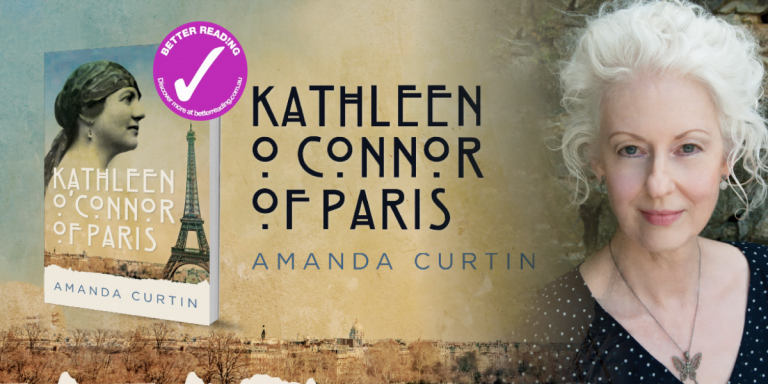
About the author:
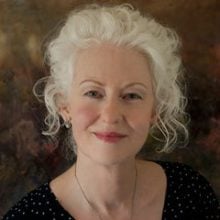
Amanda Curtin is the author of novels Elemental (2013) and The Sinkings (2008), and short story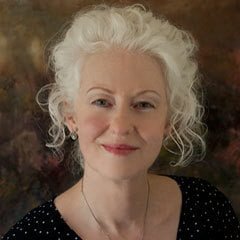 collection Inherited (2011). Elemental was shortlisted for the Western Australian Premier’s Book Awards, and in 2016 was published in the UK. Her award-winning short fiction has appeared in Griffith
Review, Southerly, Island, Indigo, Westerly, Review of Australian Fiction and several anthologies. She has also worked as a book editor for many years. Amanda lives in Perth with her husband and an opinionated Siamese cat, and works in a backyard studio among magpies, doves and old trees.
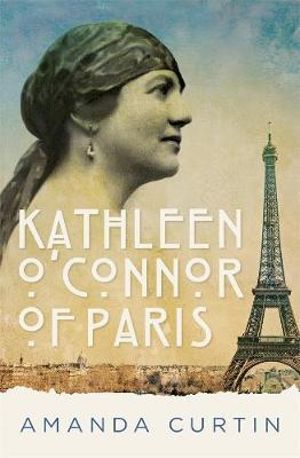
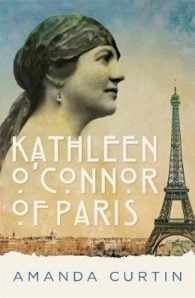
Purchase a copy of Kathleen O’Connor of Paris here
Read our full review of Kathleen O’Connor of Paris here
How have you found the transition between writing fiction and non-fiction?
There’s nothing easy about writing fiction, and the idea that it gets easier with successive books is a fallacy. But writing in this new genre was a challenging, exciting, exhausting, confronting experience, and the hardest thing I’ve done.
Does your research process differ between fiction and non-fiction?
It’s been remarkably similar, really, but that is probably because I have brought to this non-fiction project some of the strategies of research and writing that are of special importance to me when I’m working on a novel – things like site research, sensory observation. But of course, there are differences – for example, the need to be more methodical, more comprehensive – and I’ve had to learn ways to synthesise data in order for it to be meaningful, to give it ways of speaking to me.
What was the greatest challenge you faced when writing Kathleen O’Connor of Paris?
I think the greatest challenge – of many – was handling my own presence in the narrative. It was my choice to be there, of course, but it is not a familiar creative space for me to occupy. As a novelist, I am accustomed to being well out of the picture, or at least a more covert presence.
Why did you decide to submit this one to Fremantle Press?
The idea came from Fremantle Press, in the sense that publisher Georgia Richter asked me if I had any interest in writing a work of narrative non-fiction about Kate.
Was there ever a point where you felt a little intrusive, writing about someone else’s life?
It’s been 50 years since Kate’s death, a distance that tends to lessen that sense of being intrusive. Most of the materials I was working with were lodged in archives, which gives them the status of historical documents, even if some are personal in character. The point at which I should have felt most intrusive was when I was poring over the personal belongings Kate left behind, held by family custodians, but I have to confess that I was too entranced with those objects to feel that way!
There is, nevertheless, a disquieting aspect of writing about a real life: you worry about being fair, being true, being alert to the many nuances of character that make your subject unique. Whenever it felt uncomfortable, I told myself that it should be. As novelist Eva Hornung once said: it is not possible to be a writer and be comfortable.
Did you feel you had to be cautious about getting the facts right and not assuming too much?
 Facts can be slippery beasts. I was often faced with contradictory facts, gaps and absences, and the sense that ‘fact’ was the product of story or fallible memory. Narrative non-fiction is a genre that allows you to be transparent in the way you handle ambiguity and absence, how you interpret, where you speculate. I’ve chosen to write the research process and the way I’ve constructed the story into the narrative, so that my hand is visible.
Where do you write?
My house was built in 1928, originally as a shop, and I work in a studio in the back garden that used to be the shop’s storeroom. I enjoy being here among the organised clutter of my writing life – books, photos, prints, maps, boxes, files, talismans … Doves land on the windowsill, magpies practically knock on the door when they’re hungry, and the soundscape is suburban eclectic, made up of parrot chatter, dove coo, traffic and an occasional blast of Classic FM from one neighbour or heavy metal from the other.
What’s your favourite spot in Perth?
I don’t think I have one favourite spot, but I like the old suburbs of Perth where there are still traces of (admittedly European) history: Fremantle, Mount Lawley, Guildford, Bassendean. The East Perth Cemetery is a place that gives me goosebumps. The streets of my own suburb, where my husband and I walk every morning, have a calming, grounding effect – a sense of connection that comes from sunrise skies, neighbourhood dogs and cats (and their owners!), birdlife, gardens, an early-opening cafe, and a recently installed and very well-patronised street library.
How did it feel to be nominated for an Alice Award?
I feel greatly honoured to be in the company of the other nominees, accomplished women writers from around the country, and surprised and humbled even to be considered for an award that has been won by such luminaries as Kate Grenville, Clare Wright, Elizabeth Jolley and Eleanor Dark. I will always treasure the gift of this nomination.
What’s your view on the literary industry in Western Australia? How has it changed in the last five years from your point of view?
Writers continue to write and publishers continue to produce beautiful and worthwhile books, but there are market and social forces that threaten our industry, or make its work more difficult. Newspaper space dedicated to books has contracted. There is greater competition for shelf space in bookshops, and a shorter life span for books.
Much-loved neighbourhood bookshops have taken a hit from online buying, and some have been lost. Most worryingly, there is a general decline in reading that is variously attributed to competition from other forms of entertainment, changes in the human brain, the disappearance of books from the English curriculum.
But some things shine among the gloom and doom. The book club scene continues to grow, and engaged, committed readers are what every writer wants. Independent bookshops that are still with us are vibrant community hubs with knowledgeable staff who love what they do. Increasingly sophisticated bloggers are providing new spaces for reviewing books. Libraries actively support local writers, and writingWA, the state’s peak body for writing, continues to find new ways to promote Western Australian books and to connect books and readers.
Leave a Reply