
Latessaphotography.com
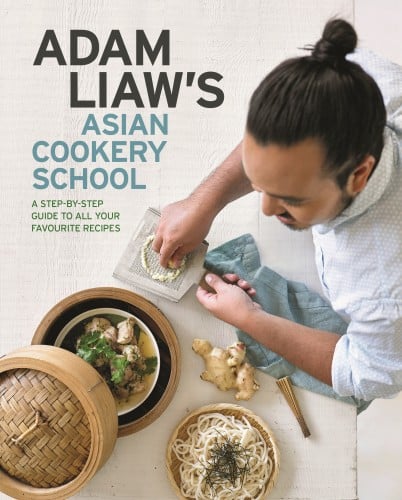
Have you ever found find yourself trying to create an Asian dish at home by chucking in as many ‘Asian’ ingredients as you can lay your hands on? But not achieving the desired result? If so, Adam Liaw’s new book, Asian Cookery School, is the cookbook for you. Sometimes, achieving the authenticity you’re after is simply about how to chop the carrot for the desired texture.
Adam Liaw takes it back to basics in his latest book, offering new insight into Asian cooking by helping us understand the various origins of recipes so we’re not simply trying to replicate what we’ve had in a restaurant – but instead re-creating the whole experience.
Recently Better Reading was lucky enough to attend an inspirational Adam Liaw cooking lesson at Williams-Sonoma Cookery School in Sydney. We’d go as far as calling it a life changing experience! From learning simple techniques, such as how to peel ginger effectively, to realising that Asian food doesn’t have to be that hard, we now know that it can be exceptionally easy. You just have to learn some of the basic techniques and that’s where Adam’s book comes in – with valuable information passed down through generations.
In his Asian Cookery School Adam Liaw takes us on a journey through Asian cooking revealing his heartfelt passion for the various cuisines of a vast continent. He talks about styles of eating and sharing, basic cooking implements to achieve the best results, menu design, textures, flavours and technique.
With each of the chapters a cookery lesson in its own right – ‘Understanding Flavour’; ‘Understanding Texture’; ‘The Wok’; ‘Poultry’; ‘Seafood’ – learning from the Asian Cookery School will open up a whole new world of cooking skills.
Try the follow dishes from the book for yourself or purchase Adam Liaw’s Asian Cookery School here.
Spinach in Sesame Dressing
This Japanese side dish is one of the most popular accompaniments to a home-style meal and it’s also a great way to get started using a mortar and pestle. You can grind the sesame as coarsely or as finely as you like.

MAKES 1 SERVE FOR SHARING
PREPARATION TIME 10 MINS COOKING TIME 1 MIN
INGREDIENTS
3 tbsp sesame seeds
2 tsp sugar
2 tsp sake
1 tsp soy sauce, plus extra for drizzling
1 bunch (about 250g) spinach
METHOD
1 Toast the sesame seeds in a dry saucepan over
medium heat and transfer to a large mortar and pestle
with the sugar. Grind to a rough paste then add the sake
and soy sauce and continue to grind until quite smooth.
2 Wash the spinach well, keeping the roots intact. Bring
a saucepan of water to a rolling boil. Place the spinach
in the pot roots first and hold the roots and stems in the
liquid for about 10 seconds, then lower the leaves into
the water and cook for 30 seconds. Remove the spinach
from the pot, drop it into a bowl of cold water to stop the
cooking, then squeeze out as much liquid as possible (use
a sushi mat if you like, or your hands).
3 Place the spinach on a large plate and drizzle with a
little soy sauce, then cut it into 5cm lengths and discard
the roots. Transfer to the mortar. Mix with the sesame
dressing but do not pound the spinach. Remove from
the mortar and serve at room temperature.
NOTES
A Japanese mortar (suribachi) has ridges inside the bowl and is used for
grinding rather than pounding, but any mortar and pestle will work fi ne.
I prefer toasting sesame seeds in a small saucepan rather than a frypan
because it allows you to swirl the seeds rather than trying to toss them in
a frypan. The swirling motion will toast the seeds more evenly.
Toasting sesame seeds brings out a strong nutty flavour, but also makes
them more brittle. The seeds will grind more easily when well toasted.
Adam Liaw’s Popcorn Chicken
Taiwanese food is a great mix of local dishes with influences from China, Japan and Southeast Asia. Popcorn chicken is a popular street food in the Taiwanese capital, Taipei, and once you try it you’ll see why. The crunchy texture of the sweet potato flour coating is incredible.

SERVES 2–4 PREPARATION TIME 20 MINS COOKING TIME 10 MINS
INGREDIENTS
600g boneless chicken thigh fillets,
preferably skin-on, cut into 3cm pieces
3 cloves garlic, peeled and minced
1 tsp grated ginger
1 tbsp soy sauce
1 tbsp Shaoxing wine
2 tsp sugar
½ tsp Chinese five spice powder
1 cup sweet potato flour
2 litres oil, for deep-frying
1 cup loosely packed Thai basil leaves
Spice salt
1 tbsp salt
¼ tsp Chinese five spice powder
¼ tsp white pepper
A pinch chilli powder
METHOD
1 Combine the chicken with the garlic, ginger, soy sauce,
Shaoxing wine, sugar and five spice powder and set aside
to marinate for at least 10 minutes.
2 Coat the chicken pieces in the sweet potato flour and
shake off any excess.
3 Heat the oil in a wok or saucepan. When the oil reaches
150°C scatter the basil leaves into the wok and stir for
about 20 seconds, or until the basil turns translucent.
Remove the basil from the wok and drain on absorbent
paper.
4 Increase the heat of the oil to 170°C and fry the chicken
in batches for about 3 minutes, or until golden brown and
cooked through, regularly skimming any floating flour bits
from the oil.
5 For the spiced salt, mix the ingredients together and
toast in a dry frypan over low–medium heat for 2 minutes,
or until fragrant. Toss the chicken with the fried basil
leaves and season with a good pinch of the spice salt.
Serve immediately.
NOTES
Sweet potato flour is sometimes sold as ‘tapioca flour’. It’s available from
Asian grocers. The Taiwanese variety is a coarse-textured but light flour that
gives the characteristic crumbly texture to this dish. You could substitute
cornflour or rice flour but it won’t quite be the same.
When deep-frying, skimming oil is a really important step that many people
overlook. It preserves the oil by keeping it clear, and stops burnt flavours
creeping in to later batches.
To purchase a copy of Adam Liaw’s Asian Cookery School click here
Cookery School Image: La Tessa Photography






Leave a Reply